(and related matters)
Produced for the centenary commemorations of the first seaplane flight in Australia, made by French airman Maurice Guillaux, 8 May 1914.
(booklet ISBN 978-0-9803693-7-3)
French aviator Maurice Guillaux spent less than 200
days in Australia in 1914. In his Bleriot IX aircraft, specially built for
aerobatic displays, he thrilled hundreds of thousands of people with his
performances. He also carried Australia’s first official air mail, from
Melbourne to Sydney, in July 1914. It is less well-known that he was the first
person to fly a seaplane in Australia.
Photographs of the time are scarce, and usually of
poor quality. An exception is this study of the ‘hydro-aeroplane’
by Sam Croft, preserved in the collection of the State Library of NSW,
catalogue # a128591
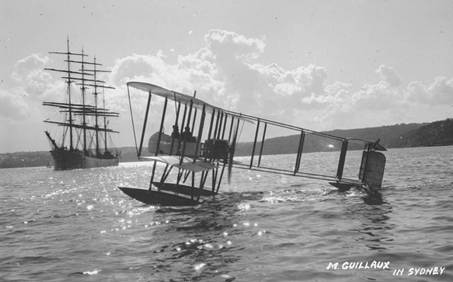
.
The young Lebbeus Hordern
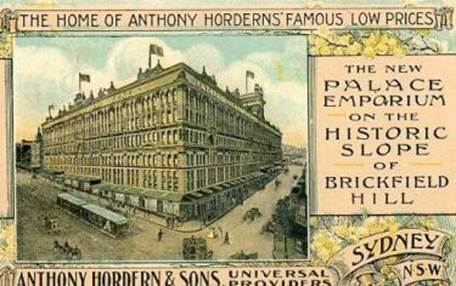 Anthony Hordern, an English free settler, set up a
drapery shop in Sydney in 1823. The various succeeding generations developed
the business, despite various intra-dynastic feuds. In 1905 a six-storey
department store was erected on the present site of World Square, George
Street, Sydney. Horderns also had a huge mail order business and was one of the
world’s great emporiums.
Anthony Hordern, an English free settler, set up a
drapery shop in Sydney in 1823. The various succeeding generations developed
the business, despite various intra-dynastic feuds. In 1905 a six-storey
department store was erected on the present site of World Square, George
Street, Sydney. Horderns also had a huge mail order business and was one of the
world’s great emporiums.
 ‘Lebbeus’ was a common given name in the family, and
in 1891 the name was given to a baby who would grow to be a joint heir of this
huge business and one of the wealthiest people in Australia.
‘Lebbeus’ was a common given name in the family, and
in 1891 the name was given to a baby who would grow to be a joint heir of this
huge business and one of the wealthiest people in Australia.
From an
early age he was an adventurer, in cars, fast boats and travel. His yacht, ‘Bronze- wing
II,’ was at the time the largest and most luxurious boat of its kind in the southern
hemisphere. He had a luxury home, ‘Hopewood ’ at Darling Point and a stud farm
at Bowral 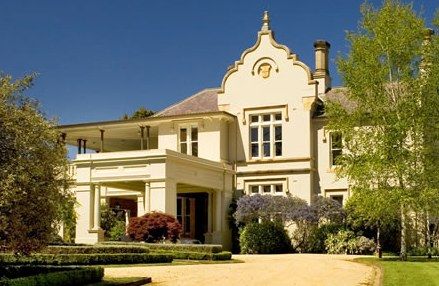 where he raised Shorthorn cattle and
thoroughbred horses.
where he raised Shorthorn cattle and
thoroughbred horses.
Hopewood
House, Bowral, is still standing, but Hopewood, Lebbeus’ home on 2½ acres at
Elizabeth Bay, has long since been demolished.
His
interest in cars led him to Jules Maillard, who owned a motor garage, first at
35 Pitt Street and later at 156A Phillip Street. Maillard sold fast cars such
as the Brasier, from France, and took part in races and rallies.
In
1913 Maillard, at the request of Lebbeus Hordern, ordered a Maurice Farman
seaplane from France. It arrived early in 1914. In preparation for the delivery of his aircraft, Lebbeus Hordern had
acquired a large block of land at the bottom of Bay Street on the foreshore of
Double Bay, upon which he had built a shed and a launching ramp.
Preparing the aircraft
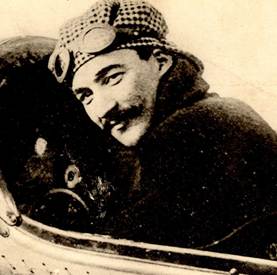 Lebbeus Hordern enlisted the services of the visiting
French aviator Maurice Guillaux and his team. They had arrived in Sydney on 8
April 1914, with their Bleriot XI aircraft which had been specially prepared
for stunt flying. Their aircraft was assembled and prepared at premises owned
by Maillard, but it is not certain that this was done at Phillip Street. For
his Sydney displays Guillaux was based at Victoria Park racecourse, at Zetland,
an inner city suburb.
Lebbeus Hordern enlisted the services of the visiting
French aviator Maurice Guillaux and his team. They had arrived in Sydney on 8
April 1914, with their Bleriot XI aircraft which had been specially prepared
for stunt flying. Their aircraft was assembled and prepared at premises owned
by Maillard, but it is not certain that this was done at Phillip Street. For
his Sydney displays Guillaux was based at Victoria Park racecourse, at Zetland,
an inner city suburb.
After an ‘ invitation only’ display at Victoria Park on Monday 21 April
1914, the Guillaux roadshow had an ‘off Broadway’ opening with its first public
aerobatic performance at Newcastle on the following Saturday. They returned to
Sydney for a major performance at Victoria Park on Saturday 2 May, and straight
after this Guillaux and his team began to erect and prepare the seaplane at the
Double Bay premises.
The machine was packed in four large cases, and weighed over
three-quarters of a ton, about 750 kg. Wingspan was 57 feet (17.3 metres), it
was 35 feet (10.6 metres) long, and 16 feet (4.0 metres) high. Engine was an eight cylinder Renault rotary engine, developing 70
horsepower, 51 kw. Maximum speed was 60 mph, about 100 km/hr. The Herald said that the machine was capable of carrying ‘two men, each of 17 stone (108 kg)
or three men of lighter build’.
It took four days to assemble. At the time, it was very important that
the aircraft was ‘rigged’ properly, with exactly the right tension on the
rigging wires that supported the wings. The trade of ‘rigger’ is vital to
aircraft that are not of modern all-metal construction.
The first flights
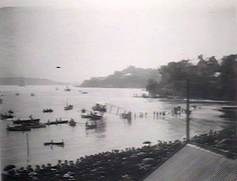
Picture:
Picture of the general scene at Double Bay: State Library of NSW, 188944, 198746
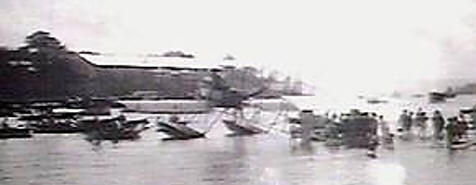
Maurice Guillaux flew the Farman for the first time on
May 8 1914, as described by the Sydney Morning Herald reporter:
Mechanics
moved about in an orderly sort of disorder. Wire stays were tightened, ash
props were tested, nuts were screwed up or slackened as required, levels were
taken, the great polished propeller was tried. It was a general tuning up of
the white-winged flying machine. And over all,
Guillaux kept a hawk-like supervision. No detail was too small for his personal
attention. At last all was ready.
‘Right to a
millimetre’ was Guillaux’s comment after he had subjected all to a minute
scrutiny……. nothing could be left to chance. Up into the pilot’s seat he
mounted, the hydro-aeroplane having been wheeled down to
the water’s edge by many willing hands. Petrol was poured into the tank, and a
mechanic [Repusseau], who looked as if he came well up to the 17 stone
standard, climbed into the passenger’s seat behind Guillaux, a dapper figure in
a tweed suit, who made no sartorial preparation for the flight beyond casting
aside his Homburg hat.
The mechanic set the propeller whirring at top speed.
So strong was the air-current which its revolutions set up, that a shower of
sand and hats was blown into the shed behind, small children wore thrown to the
ground, and the crowd holding the ‘tail’ were almost forced to let go their
hold.’
Guillaux sat himself firmly in his seat, gave the
order for release, and immediately afterwards the ‘plane was skimming along the
waters of Double Bay at breathless speed. For a few hundred yards it rushed
along, spurning the water, in a direct line for Clarke Island.
‘There she
goes!’ shouted the spectators, as they saw the far-spreading wings lifted
slowly into the air. By degrees it rose, like a great bird stretching its
pinions for height, and up it soared, its white wings showing clearly against
the dark green foliage which clothes the slopes of the opposite shore. Away
over towards Mosman it glided, as easily as if it were a bird, and then, with a
wide sweep towards the right, it sailed in the direction of Manly. It seemed to
soar right over one of the Manly boats, which sounded its siren in salutation.
For a few minutes it was lost to view, and then it re- appeared over Point
Piper. Right over the heads of the watchers at Double Bay
it flew citywards, and after a circular movement,
came back to the starting point. Landing on the water some distance out, it
made its way to the point of departure, covering the intervening distance at
the speed of an express train.
Guillaux
then took Lebbeus Hordern for a flight. He came back enraptured. ‘Flying is the
sport for me after this’ he said. The next passenger was the French Consul, M.
Chayet. Guillaux took the Herald correspondent
for a flight, and the reporter noted the vulnerability to bombing attacks of
the Australian naval ships at anchor below.
![Portrait of Louise Nellie Lovely (1895-1980), silent film actress [picture].](first%20seaplane_files/image015.jpg) The
following Monday Guillaux made twelve flights, On one
of these the passenger was Miss Louise Carbasse, then a 19
year-old Australian actress. After the war, she became a well-known
Hollywood actress under the name of Louise Lovely.
The
following Monday Guillaux made twelve flights, On one
of these the passenger was Miss Louise Carbasse, then a 19
year-old Australian actress. After the war, she became a well-known
Hollywood actress under the name of Louise Lovely.
Three days
later, in a flight above the harbour, he travelled at over 100 miles an hour,
thanks to strong tailwinds.
After the first flight
On 22 May
Guillaux and Lebbeus Hordern announced their intention to fly the seaplane from
Sydney to Melbourne, with only one stop en route, but this flight was never
attempted. At about this time, Guillaux also announced his intention to remain
permanently in Australia, making his home in Sydney. He had purchased some more
aircraft that would arrive in about three months.
During June
Guillaux was largely occupied with giving his performances. He travelled south,
performing at Wagga Wagga, Albury, Melbourne, Bendigo, Ballarat, Adelaide and,
after returning to Melbourne, at Geelong. Then on July 16-18 he made an epic
flight in his Bleriot from Melbourne to Sydney, carrying Australia’s first air
mail and air freight. This was claimed to be the longest such flight that had
been made in the world at the time. Liptons tea and
O.T. juice, sponsors of the flight, mounted huge advertising campaigns and the
entire population was aware of this great achievement.
Meanwhile
the seaplane was used intermittently. Guillaux himself had returned to Sydney
from Melbourne by train for a few days before his performance in Bendigo (8
June) and made several flights with the seaplane. He is also recorded as flying
the seaplane in the week beginning 24 July.
The outbreak of World War I
Only a
fortnight after the mail flight, war broke out. This completely dominated the
newspapers, and largely for this reason Guillaux’ mail-carrying feat is now not
widely known. The Herald reported Guillaux’ eagerness to return to France, but
these plans were delayed by a bad crash on August 1 in his Bleriot, at Ascot
Racecourse in Sydney. This area is now part of Kingsford-Smith airport.
Guillaux was incapacitated for a few weeks, then, when his aircraft had been
repaired, he performed in Newcastle and Bathurst. Guillaux eventually sailed
for Europe on HMAT Orvieto on October
22. He accompanied the Headquarters staff of the First Australian Division,
listed as ‘Aviator’, and travelled with an unnamed attendant. He was killed in
France on 21 May 1917, while testing a new aircraft.
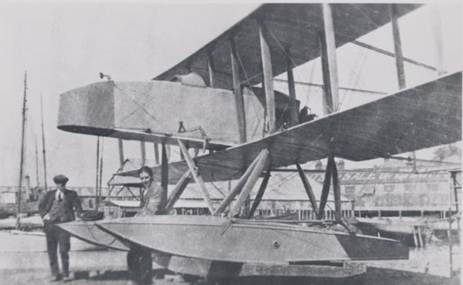 CFS 7. Picture:
http://www.adf-gallery.com.au/
CFS 7. Picture:
http://www.adf-gallery.com.au/
At the
outbreak of war Hordern presented his
seaplane to the Australian Government and the aircraft was taken on strength at
Point Cook as CFS7, in other words the seventh aircraft, and the first
seaplane, of what eventually became the RAAF.
It was fitted with two main sprung floats and a small tail
float. The crew nacelle was positioned on the lower wing, and
carried two seats with the pilot in the forward position.
The seaplane was meant for use as a two-seat training and
reconnaissance aircraft.
The seaplane goes to war
In 1884-5 Germany had colonised Kaiser Wilhelmsland
(north eastern New Guinea) and the Bismarck
Archipelago (New Britain and New Ireland), Nauru, the Marshall Islands and the
northern Solomon Islands (Buka, Bougainville and other islands). When the war
broke out in 1914, the German settlements were potential, and in some cases
actual, calling places for German raiding ships. Many Australians had regarded
the German colonies as intrusions on Australia’s sphere of influence, and there
was strong support for an expedition which was sent to capture them.
The capital of the combined German colonial area was
Rabaul, and it was captured by Australian forces during the period 11-13 September. There was a
minor conflict with, on the Australian side, six men were killed and four
wounded. Only a few hundred Australian troops and sailors were involved in the
fighting, and the Germans had less than 100 soldiers plus a native levy of
about 110 men. The natives were, not surprisingly, not very enthusiastic
soldiers. Madang was taken without resistance on 24 September.
The following month the Komet, a
modern a service vessel for the German possessions in the area, was captured by
the Australians. Komet was quickly
equipped 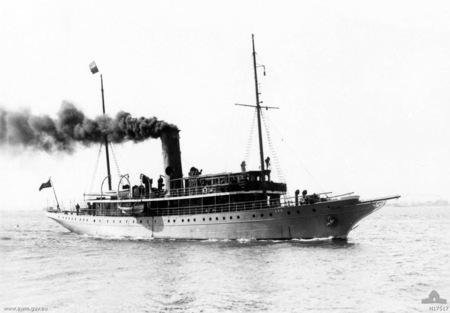 with three 4-inch guns and other weapons, and commissioned as HMAS Una on 17 November.
At noon on 27 November orders were received at Point Cook to
send the Farman seaplane and a BE 2C aircraft to Sydney to be loaded on Una for military service. The aircraft
were dismantled and a few hours later were on the train to Sydney. By 2 30 on
29 November the Una’s captain
reported that the aircraft, the airmen, and the necessary spare parts, supplies
etc were on board. This was a remarkable feat of logistics. Members of this
first expeditionary force were Lieutenant Harrison, officer in charge, Lieutenant
Merz as the second pilot, Sergeant Shortland and,
Private McIntosh, Private Mason and Private Pivot. These two aircraft were the
first in the British Commonwealth to be sent overseas for action.
Australia at first planned to take German positions such as Yap Island,
and Una was to be part of this force.
However, Japan (a naval ally of Britain in World War I) was moving into these
areas, and on December 3 the British Government asked Australia not to
intervene, because it was important to keep a good relationship with Japan.
Australia was to restrict itself to operations south of the equator.
There was some radio communication among the ships of the force, and
even with Australia, but it was not reliable. Sometimes it took days for a
message to be received, because of ‘atmospherics’, (‘static’ and other
interference), the primitive quality of the equipment, and of inexperience of
the operators. Messages, when received, were often garbled. The result was that
coodination of forces was very difficult.
Una, with its aircraft, arrived at
Rabaul on December 17. It had been delayed by the need to load 200 tons of coal
fuel. With other vessels, she was then
sent to take over, and if necessary to subdue, the remaining German settlements
throughout Kaiser Wilhelmsland.
Una visited many former German
settlements, but there was no resistance to an Australian take-over, and the
aircraft were never used. The main task of the administrators carried by Una was to explain to the natives that
they had new colonial masters.
The German possessions received new names eg the Admiralty Island group
(principally Manus Island), New Ireland and New Britain. After the war, they
became ‘mandated’ territories, ruled by Australia and nominally under the
control and supervision of the League of Nations. Under the same procedure,
Japan retained control of many other former German possessions.
Return to Point Cook
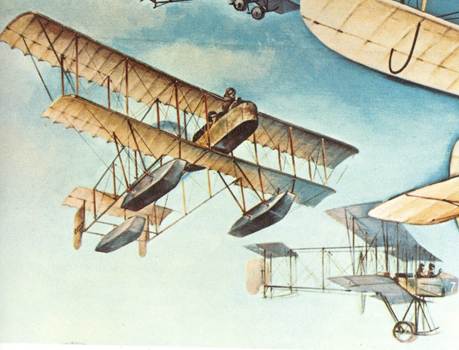
The Farman seaplane
is seen, both in its seaplane and landplane forms, in this picture from Military Aircraft
of Australia, 1909-18, by Keith Isaacs,
AWM 1971.
During 1915 the Farman returned to Point Cook and was
reconstructed as a landplane. It was occasionally used as a trainer if the
Bristol Boxkites were unserviceable. On 20 July 1916 it was re-equipped with an
Australian licence-built Renault engine, constructed by Tarrant Motors in
Melbourne. The last recorded mention of the aircraft as on 30 June 1917 when it
was officially listed as one ‘Maurice Farman Biplane (converted)—for
instructional use’.
Hordern himself went to war, serving in the British Royal Field Artillery as a lieutenant, and was invalided home in 1917 suffering from gas poisoning. The rest of his story can be read in the Lebbeus Hordern archive