Lebbeus Hordern...
Contents
The Hordern
Dynasty success story
1919:
Inauguration of The Aerial Company
The
waterborne aircraft of The Aerial Company
The coastal
survey flight, Q-AUCV, 1921
Horrie
Miller: last hurrah of the Seagulls
It is very hard to write a concise buigraphy of Lebbeus Hordern. This little booklet concentrates on his influence in early Australian aviation but cannot avoid the other factors in his short life which both led to his great achievements and almost simultaneously contributed to his downfall.
We begin with looking at his family background and early life (pages 2 to 5). At the age of 23, he imported Australia’s first seaplane and awakened Australia to the potential for aviation and particularly of ‘hydro-aeroplanes’ (pages 6 to 8). After World War I (pages 8 to 10) he was a prime mover in setting up The Aerial Company, page which was probably the most ambitious of the many contemporary attempts to establish commercial aviation. We describe the aircraft imported (pages 12 to 16) and describe their two ambitious pioneering undertakings: the 1921 coastal survey, Sydney to Launceston (pages 16 to 20) and the New Guinea expedition of 1922 (pages 21 to24). Horrie Miller, a great Australian aviation pioneer, tried to establish a seaplane airline with no success, (pages 26 to 26) and this was the end of Lebbeus’ aircraft. The rest of the story is personal: divorce (pages 27 to28 ) and the last few years of his life (pages28 to 31). We conclude with a brief outline of the aftermath of the life of this amazing character.
Tom Lockley, 1 January 2026
The Hordern Dynasty success story
 Anthony Hordern (1788-1869) and his wife Ann
(1791-1871)) migrated to Sydney in 1823, 45 years after Britain established the
settlement as a dumping ground for convicted criminals. Sydney was gaining a
reputation as a place where money could be made: there
were large pastoral holdings and the wool trade was
developing. The upper class had money to spend on luxury goods.
Anthony Hordern (1788-1869) and his wife Ann
(1791-1871)) migrated to Sydney in 1823, 45 years after Britain established the
settlement as a dumping ground for convicted criminals. Sydney was gaining a
reputation as a place where money could be made: there
were large pastoral holdings and the wool trade was
developing. The upper class had money to spend on luxury goods.
Anthony set up business as a 'coachmaker, wheelwright and smith' and later as a grocer and publican. His wife opened a shop at 12 King Street as a ‘haberdasher and bonnet and corsetmaker’. Her advertisement, above, in The Sydney Herald of 3 April 1834 is said to be the first display advertisement in the Australian press, setting a pattern for innovative marketing that led to great success.
There were some intra-family squabbles, and some family members set up competing establishments. But two generations later Anthony Hordern & Sons was the largest retail store in Sydney with its huge store on Brickfield Hill, pictured on the next page, built in 1905.
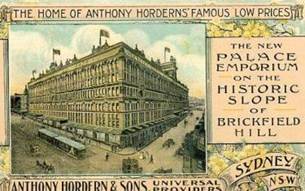
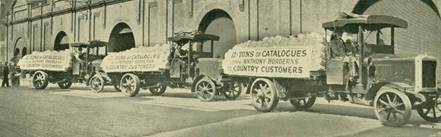 Anthony Horderns proudly boasted of being
‘universal providers’, stocking ‘anything from a needle to an anchor’. The
store built up a huge mail-order retail operation: in country areas the annual
mail order catalogue was eagerly anticipated, and hundreds of thousands of
orders were placed.
Anthony Horderns proudly boasted of being
‘universal providers’, stocking ‘anything from a needle to an anchor’. The
store built up a huge mail-order retail operation: in country areas the annual
mail order catalogue was eagerly anticipated, and hundreds of thousands of
orders were placed.
At the turn of the century, Samuel Hordern was the principal owner of Anthony Hordern & Sons. On his death in August 1909 his estate was valued at £2,925,925. Samuel junior (1876-1956), the eldest son assumed leadership: he was a typical member of the Hordern succession: abstemious, devout Anglican, with a strong moral code and vigorous work ethic, he maintained strong control over the enterprise: it is said that he was driven to the store daily with the keys to unlock the building. He had a good reputation for maintaining staff welfare and for charitable work, and for public benefactions.
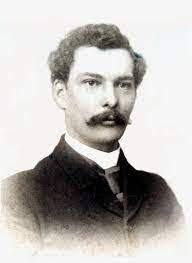 When Anthony Horderns was reorganised as a
private company in 1912, shares were divided among Samuel senior’s widow and
children, the three sons being far more favourably treated!
When Anthony Horderns was reorganised as a
private company in 1912, shares were divided among Samuel senior’s widow and
children, the three sons being far more favourably treated!
For example, son Lebbeus at age 18 acquired a huge income – at least £10,000 per annum plus dividends – and this was held in trust until he turned 21, making a massive sum available to him.
He took little interest in the business. His strength was in spending money, not making it. So the rest of this booklet is devoted to his story.
A few days after turning 21, Lebbeus announced his intention to marry the beautiful young Olga Monie. Her family was quite wealthy, but not to the level of the Horderns. She was also Catholic, which did not please the staunchly Anglican Hordern family.
The actual ceremony occurred in the sacristy of St Mary’s
Cathedral: Lebbeus did not convert to Catholicism. Yet the marriage, on October
18 1912, was a major social event of the year and
widely reported. The newspapers rapturously described the dresses of the ladies
of the bridal party: the four bridesmaids wore expensive diamond pendants
purchased by Lebbeus. He had also purchased from London a ‘going-away’
motor car that was ‘like a small rose garden glassed in and mounted on rubber
tyres’. The pair immediately departed on around the world honeymoon, returning
in the New Year. Their activities were widely reported in the press as Lebbeus
embarked on a spending spree. Among many other enterprises, he built a luxury
mansion, ‘Hopewood ’ at Darling Point and a stud farm at Bowral, famous for its
Shorthorn cattle and blood horses.
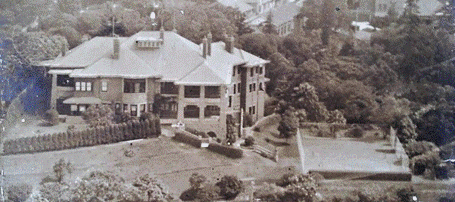
Hopewood House, Bowral, is still standing, but Hopewood, Lebbeus’ home on 2½ acres at Elizabeth Bay, has long since been demolished. On its site an 18-storey of luxury home units stands in the original one-hectare area sie, with a beautiful garden area.
On 4 April 1914, Olga gave birth to a son, also named Lebbeus.
Lebbeus’ first aircraft
Lebbeus always had the best cars and boats. His yacht, ‘Bronzewing II,’ was at the time was the largest and most luxurious boat of its kind in the southern hemisphere. His interest in cars led him to Jules Maillard, who owned a motor garage, first at 35 Pitt Street and later at 156A Phillip Street. Maillard sold fast cars such as the Brasier, from France, and took part in races and rallies.
Maillard acted as agent for Lebbeus in the purchase of a Farman ‘hydro-aeroplane’ at a cost of £1,600.
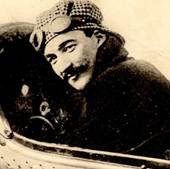 Lebbeus housed the
aircraft in a shed at Double Bay, He very wisely enlisted the services of the
visiting French aviator Maurice Guillaux and his team to assemble it. Maurice
had arrived in Sydney on 8 April 1914, with their Bleriot XI aircraft which had
been specially prepared for stunt flying. They assembled and prepared the
Blériot at premises owned by Maillard.
Lebbeus housed the
aircraft in a shed at Double Bay, He very wisely enlisted the services of the
visiting French aviator Maurice Guillaux and his team to assemble it. Maurice
had arrived in Sydney on 8 April 1914, with their Bleriot XI aircraft which had
been specially prepared for stunt flying. They assembled and prepared the
Blériot at premises owned by Maillard.
The Farman was packed in four large cases, and weighed over three-quarters of ton, about 750 kg. Wingspan was 57 feet (17.3 metres), it was 35 feet (10.6 metres) long.. Engine was an eight cylinder Renault rotary engine, developing 70 horsepower, 51 kw. Maximum speed was 60 mph, about 100 km/hr.
It took four days to assemble the Farman. At the time, it
was very important that the aircraft was ‘rigged’ properly, with exactly the
right tension on the rigging wires that supported the wings. The Herald reporter
noted the skill with which Maurice
prepared the aircraft.
![Portrait of Louise Nellie Lovely (1895-1980), silent film actress [picture].](Lebbeus%20Hordern_files/image013.jpg) On 5 May the machine flew for the first
time. The passenger was Jacques Repusseau, Maurice’s 18 stone (114 kg)
mechanic. Lebbeus was the next passenger: he came back enraptured. ‘Flying is
the sport for me after this’ he said. Over the next few months
the aircraft was often in the news. Passengers included politicians and
military leaders, and celebrities such as Miss Louise Carbasse, then a 19 year-old Australian actress, later to become a well-known
Hollywood actress under the name of Louise Lovely.
On 5 May the machine flew for the first
time. The passenger was Jacques Repusseau, Maurice’s 18 stone (114 kg)
mechanic. Lebbeus was the next passenger: he came back enraptured. ‘Flying is
the sport for me after this’ he said. Over the next few months
the aircraft was often in the news. Passengers included politicians and
military leaders, and celebrities such as Miss Louise Carbasse, then a 19 year-old Australian actress, later to become a well-known
Hollywood actress under the name of Louise Lovely. 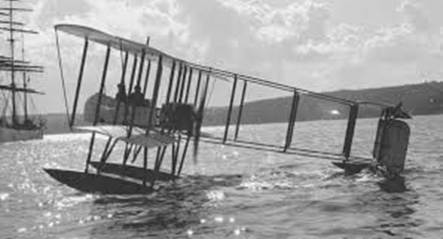
Iconic picture of the Farman
After the first flights
Guillaux gave Lebbeus some flying lessons, but later reports indicated that his flying was characterised by recklessness rather than skill. His younger brother is quoted as saying ‘Go up in Lebby’s plane if you like, but for heaven's sake don't go up with Lebby!’
On 22 May Guillaux and Lebbeus Hordern announced their intention to fly the seaplane from Sydney to Melbourne, with only one stop en route, but this flight was never attempted. At about this time, Guillaux also announced his intention to remain permanently in Australia, making his home in Sydney. He had organised the purchase of some more aircraft that would arrive in about three months.
Guillaux continued his exciting program of display flights in south-east Australia and made the first flight from Melbourne to Sydney in his Blériot. But in September, war broke out. This completely dominated the newspapers. Guillaux returned to France to take part.
World War I
Lebbeus’ Farman goes to war
At the outbreak of war Lebbeus presented his seaplane to the Australian Government and the aircraft was taken on strength at Point Cook as CFS7, in other words the seventh aircraft, and the first seaplane, of what eventually became the RAAF.
On 27 November1914 orders were received at Point Cook for
the Farman seaplane and a BE 2C aircraft to Sydney to be sent overseas for
military service. The aircraft were dismantled and a few hours later were on
the train to Sydney. Two days later the aircraft. two pilots and a support crew
were on board HMAS Una, which sailed on an expedition to the north of Australia
to take over former German colonies These two aircraft were the first in the
British Commonwealth to be sent overseas for action.
Australia at first planned to take German positions such as Yap Island. However, Japan (a naval ally of Britain in World War I) was moving into these areas, and on December 3 the British Government asked Australia not to intervene, because it was important to keep a good relationship with Japan. Australia was to restrict itself to operations south of the equator.
During 1915 the Farman returned to Point Cook and was reconstructed as a landplane. It was occasionally used as a trainer if the Bristol Boxkites were unserviceable.
On 20 July 1916 it was re-equipped with an Australian licence-built Renault engine, constructed by Tarrant Motors in Melbourne.
The last recorded mention of the aircraft was on 30 June 1917 when it was officially listed as one ‘Maurice Farman Biplane (converted)—for instructional use’.
Lebbeus goes to war…
In May 1915 Hordern himself went to war, with plenty of coverage in the press. The Sydney Telegraph reported that he intended to buy his own aircraft, and fight in the air. He and Olga caught the train to Adelaide to embark on a fast ship for England. We next hear in August that ‘he has a commission in the Royal flying Corps’. The baby son was taken separately to join his mother in December, and Olga is recorded as taking a prominent part in welfare work for sources different for soldiers at the front and their families.
In March he was reported as serving in the British Royal Field Artillery as a lieutenant after he was rejected by the Royal flying Corps because of poor eyesight .In June 1916 he was in hospital in England suffering from shellshock and the effects of poison gas.
… and returns to Australia
Olga and Lebbeus returned to Australia in February 1918, ostensibly for a six months ‘furlough’. They resumed their place in Sydney society, though not with the prominence that characterised their marriage in the first few years. Lebbeus and other wealthy people received a lot of publicity for their contributions to the war loans.
Newspaper reports indicate that Olga left Sydney in August 1919 to live in Europe, taking Lebbeus junior with her. This story is continued on page 27.
1919: Inauguration of The Aerial Company
After the war there was considerable interest in commercial aviation.
The best-funded operation was probably The Aerial Company, which was registered in Sydney in April 1919 with its office in Martin Place and authorised capital of £20,000. Chairman and founder was H C Macfie, Managing Director was Lebbeus Hordern, and General Manager was Lieutenant- Colonel Woods.
Lebbeus spent the early part of 1920 overseas, purchasing aircraft and getting up to other mischief as described on page 27.
The Aerial Company imported a few de Havilland 6 landplanes. The first official flight of The Aerial Company was on July 4, 1919. In October 1919 Captain Ryrie flew to Parkes, Orange, Forbes, Grenfell, Cowra, Harden, Yass and Goulburn, then the highlight was a landing at Hopewood House, Lebbeus’ opulent mansion at Bowral, before returning to Sydney.
Lebbeus, incidentally, promoted the safety of aircraft, stressing The Aerial Company’s attention to safe operation, and fulminating in the press about airmen who flew low over settled areas.
Lebbeus was mainly interested the waterborne aircraft – two Curtiss Seagulls, a Short Shrimp and a Felixstowe F3a which he had purchased during his time in England.
The waterborne aircraft of The Aerial Company
(These details largely come from David Eyre’s authoritative Aeropedia website.)
The Curtiss Seagulls
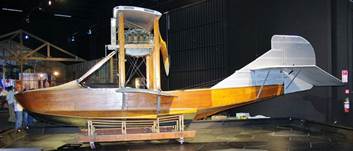 The Curtiss Seagull was a very successful flying boat of
World War I, made in the USA. The example pictured is a rare survivor, at the Omaka
Heritage Centre in New Zealand. The wooden hull was beautifully made, but was
not durable, especially in difficult weather conditions. The Seagulls carried
two people over a maximum range of 450 kilometres at a maximum speed of 125
kilometres an hour
The Curtiss Seagull was a very successful flying boat of
World War I, made in the USA. The example pictured is a rare survivor, at the Omaka
Heritage Centre in New Zealand. The wooden hull was beautifully made, but was
not durable, especially in difficult weather conditions. The Seagulls carried
two people over a maximum range of 450 kilometres at a maximum speed of 125
kilometres an hour
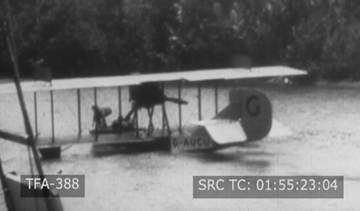
Only two examples came to Australia, registered as G-AUCV and G-AUCU. Both arrived early in 1921.
AUCV was soon registered, and left Sydney on 13 March 1921 and made an epic flight to and from Tasmania as described on page 16. Some sources say that it also went to New Guinea but I cannot confirm this.
G-AUCU was registered on 28 June 1921 to Aerial Company Ltd. Ownership was shortly after transferred to Lebbeus Hordern, who made some flights in it. It took part in Frank Hrley’s New Guinea expedition of 1922, page 21.
Both aircraft were taken over by Horrie Miller of Macrobertson Miller Aircraft and the subsequent history can be seen on page 26.
The registration of G-AUCU lapsed on 31 January 1925: no
other details are known. 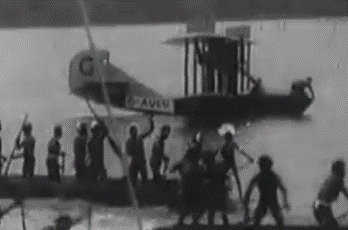
The Short Shrimp
G-AUPZ was purchased by Lebbeus Hordern in February 1920 for £2700 and shipped to Australia for another £1200 in June 1921. It took part in the 1921 New Guinea expedition as described later. It was a three seater seaplane with a maximum speed of 135 kilometres an hour. Only three were built.
On its return from New Guinea it was re-assembled at Double Bay, NSW and, on 20 January 1923, flown by Andrew Lang with Mr Alec Hill as passenger, it left Double Bay to fly the short distance to Botany Bay. However it was caught in wind turbulence and crashed near Point Piper in Sydney and sent to the harbour bottom. The pilot and passenger escaped, and the aircraft was salvaged but written off. There was a report at this time to the effect that the Shrimp had a total of less than 6 hours flying time, and certainly it was not widely used.
Felixstowe F3: the lost dream
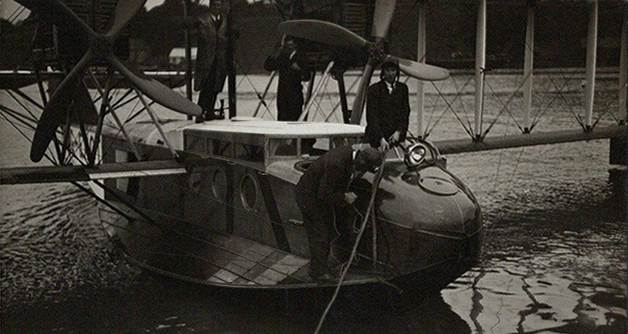 G-EAQT was to be the flagship aircraft
for The Aerial Company, but it was a huge disappointment. It never flew in
Australia.
G-EAQT was to be the flagship aircraft
for The Aerial Company, but it was a huge disappointment. It never flew in
Australia.
About 100 F3s were built as military aircraft during the
war, and two were later remodelled for civil use. EAQT, seen in the 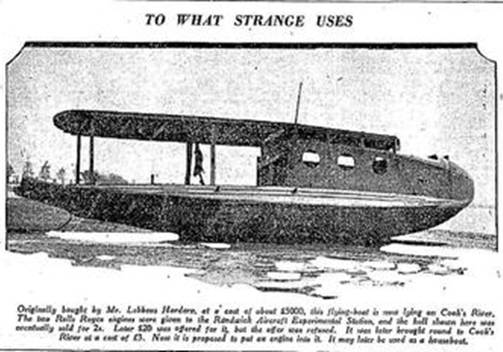 Short Brothers photo above, was fitted
out with three lounges, upholstered in green and grey, in the cabin, and ten
passengers could be carried. The F3 was purchased by Lebbeus Hordern on behalf
of The Aerial Company for £15,500.
Short Brothers photo above, was fitted
out with three lounges, upholstered in green and grey, in the cabin, and ten
passengers could be carried. The F3 was purchased by Lebbeus Hordern on behalf
of The Aerial Company for £15,500.
It arrived in Sydney on 23 August 1920 and was taken to Botany Bay, where the company had built a hangar. They hoped to develop an international air service to New Zealand, Papua New Guinea and Singapore, an ambitious task for this aircraft. But when it was unpacked, it was found that the wooden fuselage had been damaged in transit. The aircraft was never assembled: the wings were never even uncrated.
In July 1923 Lebbeus accompanied Charles Kingsford Smith and Keith Anderson to inspect the aircraft: they were looking for an aeroplane to fly the Pacific. They decided that the deterioration to the hull was so great that repairs would be uneconomic. In late 1925 Hordern again offered the Felixstowe to Kingsford Smith for £1,000. Kingsford Smith had the machine inspected by Lawrence Wackett who confirmed this judgement. In addition, maximum range was less than 1000 miles, 1600 kilometres, which was inadequate for Smith’s purposes.
The hull deteriorated even further and it
became a fishing shack. The Sun of 17 November 1926 showed this picture, and records
that the two Rolls-Royce engines had been given to the Randwick Experimental
Station (led by Lawrence Wackett). The hull was eventually sold for £3 but was broken up when plans to
use it as houseboat did not eventuate.
It remains significant as the first luxury airliner to reach Australia, and indeed probably the first VIP aircraft. Its failure was one of the misfortunes that befell Lebbeus in the next few years, which, as we will see, probably led to serious depression and premature death.
The coastal survey flight, Q-AUCV, 1921
With the arrival of the first Seagull Lebbeus lost little time in putting into action his plans to survey the Australian coast, beginning with the east coast south of Sydney. This would identify possible landing places for his anticipated air services. They sought areas of smooth water, with a shelving sandy beach where they could run the aircraft onshore for loading and unloading. Shelter from winds was also important. The plan was eventually to establish fully equipped bases at suitable intervals along the coast.
 An escort vessel had been purchased –
named Acielle, for the Aircraft Company. It was built in
Tasmania and was a seaworthy 30-ton auxiliary yacht. It cruised at a speed of 8
knots, and was equipped with an electric generator
which provided general illumination and a film processing studio. Crew
facilities were excellent: there were three three-berth cabins for the seven
crew, all returned servicemen. L/R: Andrew Lang, Frederick Laidler, Jack Watson, Alex Hill
Frank Chandos and Charles Snook
An escort vessel had been purchased –
named Acielle, for the Aircraft Company. It was built in
Tasmania and was a seaworthy 30-ton auxiliary yacht. It cruised at a speed of 8
knots, and was equipped with an electric generator
which provided general illumination and a film processing studio. Crew
facilities were excellent: there were three three-berth cabins for the seven
crew, all returned servicemen. L/R: Andrew Lang, Frederick Laidler, Jack Watson, Alex Hill
Frank Chandos and Charles Snook
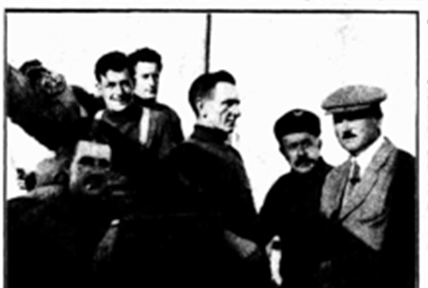 The captain, Charles Snook, had served as
a pilot in the Royal Flying Corps in France, with a spell as prisoner of war
after crashing behind enemy lines. After he returned home in 1920
he formed a small aviation company but then joined The Aerial Company. Jack
Watson and Frank Chandos were boat crew, Frederic Laidler was aircraft mechanic
and Alex Hill was aircraft rigger and photographer.
The captain, Charles Snook, had served as
a pilot in the Royal Flying Corps in France, with a spell as prisoner of war
after crashing behind enemy lines. After he returned home in 1920
he formed a small aviation company but then joined The Aerial Company. Jack
Watson and Frank Chandos were boat crew, Frederic Laidler was aircraft mechanic
and Alex Hill was aircraft rigger and photographer.
The pilot Lebbeus chose, Andrew Lang, was an experienced
wartime aviator: as test pilot he claimed to have flown 53 types of aircraft,
and held the record for altitude flight, 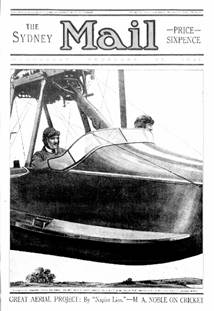 reaching 30,000 feet, an amazing
achievement considering the primitive oxygen equipment used. He was a skilled
mechanic and also a popular journalist. He was from an
upper-class family, and as a journalist wrote under the pseudonym ‘Napier
Lion’. He wrote a
regular motoring column in the Sydney Mail, and on February 23 1921, the front page (left) announced coverage of the
coastal flight. Weekly articles described the flight in considerable detail:
Andrew was a very ‘discursive’ writer – he mentioned many towns he flew over,
with their special features; he talked a lot about the people he met and went
into detail about the idiosyncrasies of the aircraft. The life stories of the
crew members often featured. All in all, these are very interesting examples of
contemporary media when people had lots of time to read.
reaching 30,000 feet, an amazing
achievement considering the primitive oxygen equipment used. He was a skilled
mechanic and also a popular journalist. He was from an
upper-class family, and as a journalist wrote under the pseudonym ‘Napier
Lion’. He wrote a
regular motoring column in the Sydney Mail, and on February 23 1921, the front page (left) announced coverage of the
coastal flight. Weekly articles described the flight in considerable detail:
Andrew was a very ‘discursive’ writer – he mentioned many towns he flew over,
with their special features; he talked a lot about the people he met and went
into detail about the idiosyncrasies of the aircraft. The life stories of the
crew members often featured. All in all, these are very interesting examples of
contemporary media when people had lots of time to read.
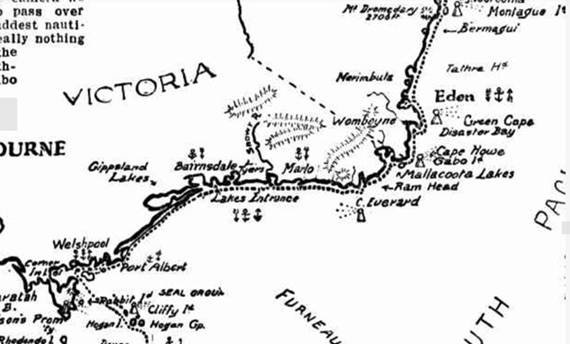
His work was very popular, but it makes it difficult to construct a clear timeline of what happened. The Mail published a map which assists understanding; extracts are seen on the next pages
They departed Sydney on March 13, and returned on July 4, a total of 16 weeks and one day. There were several lengthy delays, for example eight days at Jervis Bay. A storm at Eden almost caused disaster, averted when Lang took off and flew to a sheltered area. It took a month to reach Lakes Entrance.
Because
of Lang’s discursive writing style, it is hard to work out an exact
chronology. These maps were adapted from those published in the Sydney
Mail.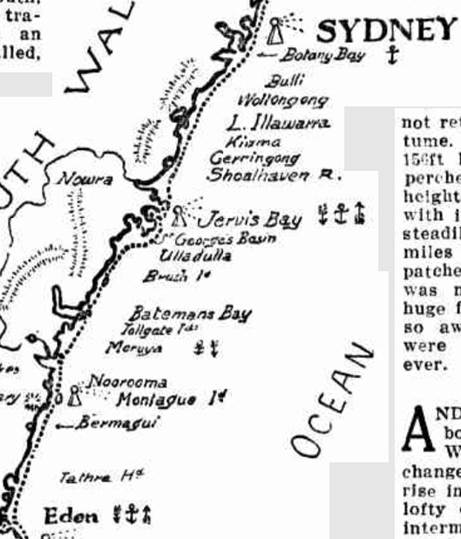
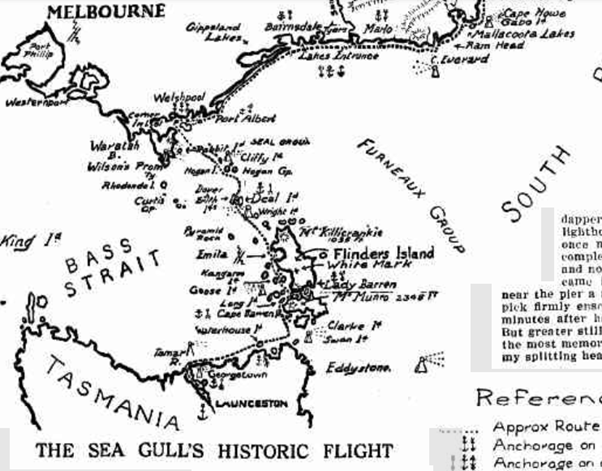
At Welshpool minor wing and fabric repairs were done and the magneto replaced before crossing Bass Strait. Mail was delivered to the Deal Island lighthouse. They stayed overnight at Lady Barron, a village on the south of Flinders Island, then landed in the Tamar River at Launceston on 29 May. They performed major maintenance and made several flights over Launceston and departed 19 June, crossing the Bass Strait via George Town and Cape Barron Island. The original plan to fly via King Island to Melbourne was abandoned.
The return journey took only ten days.
The total journey was nearly 1700 miles, 2700 km, flight time about 36 ½ hours, average speed 46.5 mph, 75 km/hr.
The New
Guinea expedition
Lebbeus lent the Curtiss Seagull G-AUCU and the Short Shrimp to an expedition to New Guinea (August 1922 to led by the famous reporter and cameraman Frank Hurley. Andrew Lang and Alex Hill were once again the principal aviators.
 The
Shrimp and AUCU were unloaded at Hanuabada, a suburb of Port Moresby,
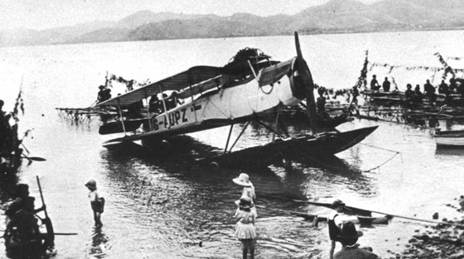
characterised by a group of native houses erected on poles set into the sea.. There are many pictures of the Shrimp being unloaded,
but I have not seen a picture of it airborne, The
ambitious plans for it to survey the Fly River were quietly shelved.
The
Shrimp and AUCU were unloaded at Hanuabada, a suburb of Port Moresby,
characterised by a group of native houses erected on poles set into the sea.. There are many pictures of the Shrimp being unloaded,
but I have not seen a picture of it airborne, The
ambitious plans for it to survey the Fly River were quietly shelved.
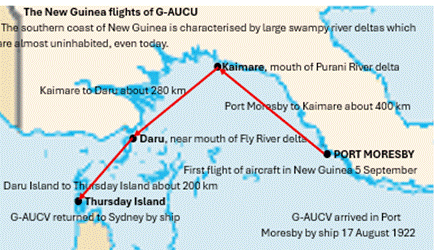
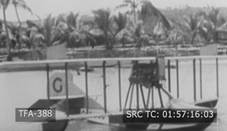
AUCU explored the coast of New Guinea east of Port Moresby. Leaving Port Moresby on October 4, the party proceeded to Kalmare, on the Purari delta, then across the mouth of the Fly River, to Daru. a flight of some 402 km (250 miles) in heavy rain. Frank Hurley wrote that ‘this was difficult, risky flying; no aeroplane had ever before ridden these skies; there were no safe landing places for the finely-made mahogany hull which would have been quickly gutted by the floating debris common along the coastline’.
There was no radio contact with any shore base and little chance of assistance in an emergency; weather and atmospheric conditions were unchartered.
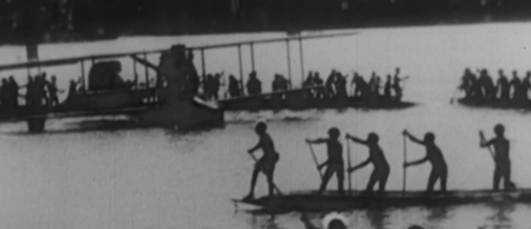
In this area the ‘cargo cult’ phenomenon was becoming evident. Many natives believed that the gods would send them shiploads of wonderful goods, as they were already doing for the white people. The ‘flying steamer,’ as they called it, was seen as a harbinger of the bounty that was to come. There is a movie sequence showing some New Guineans ceremonially presenting a pig to the aircraft.
The time and date details for this expedition are not readily available, and the map above is only useful for giving an idea of distances and to underline the fact that it was easier to fly from Daru to Thursday Island than to return to Port Moresby. A lot of repair work was done at Daru on the aircraft in preparation for the flight up the Fly River, but Lang said that ‘owing to the effects on the machine caused by terrific rain the project had to be abandoned’. During the week they spent at the Fly River mouth over 12 inches of rain fell.
The machine had been exposed to the weather for about 14 weeks. ‘About two inches fell nightly, and the best of the day was scorching. Within another fortnight the machine would have been useless, as the wings already showed signs of decay’ … ‘nobody could be impressed with the country around the Fly River. Mud was everywhere—so were mosquitoes. The only machine which could stand the exposure would be one built entirely of metal with a very powerful engine’. He was right: after 1926 people like Ray Parer were early aviators in New Guinea, and some amazing things were done with wooden-based aircraft, but the arrival of all-metal aircraft like the Junkers W50 made a huge difference.
Shrimp at Port Moresby
Hurley returned to New Guinea the following year, without the aircraft. The expeditions were recorded in still photographs and various versions of a movie, ‘Pearls and Savages’. It was shown in Australia and overseas, but was not a profit-making venture for Hurley, who did not follow it up with more activities in New Guinea. He also had some problems with government authorities who accused him of taking unique artefacts from various places. This was contentious: Hurley stated that he had paid more than twice the locals’ asking prices, and that he was working as an agent of the Australian Museum. But that is another story!
There is little doubt that both Hordern and the Hurley expedition were disappointed by the problems encountered with the aircraft, though they concealed it well. But the fact remains that these were first aircraft to be seen in New Guinea: it was not until 1926 that aviation became important, and it quickly established itself as a necessity for efficient transport around this mountainous, jungle covered country.
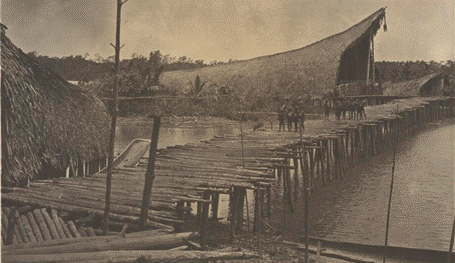
Longhouse at Daru
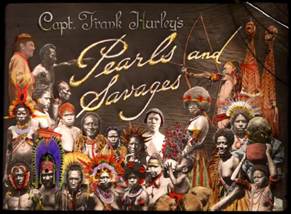 Pearls and
Savages: some stills:There were several versions of this movie, shown
world-wide
Pearls and
Savages: some stills:There were several versions of this movie, shown
world-wide
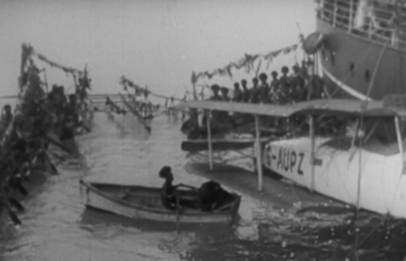 Unloading the Shrimp, Hanuabada
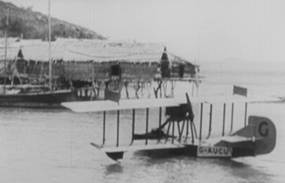
AUCU (near the Shrimp) A model – Cargo cult?
AUCU at Daru
Stand-up paddlers …and a pig for AUCU
Horrie Miller: last hurrah of the Seagulls
Lieutenant H C ‘Horrie’ Miller is another Australian
aviation pioneer who does not get the recognition he deserves. In 1924 he had
the idea to use the two Curtiss seaplanes. based on Adelaide. For example, the
journey across Spencer Gulf to Port Lincoln could be done in two hours, far
quicker than travelling by land or by boat.
 The fundamental problem with the air service
was keeping the aircraft safe when moored, and the project was abandoned.
The fundamental problem with the air service
was keeping the aircraft safe when moored, and the project was abandoned.
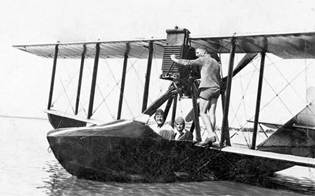
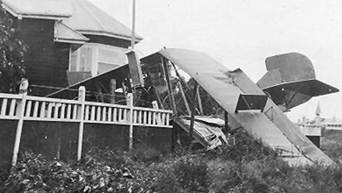 Above:
Horrie starts the Seagull’s engine for a joyflight,
Glenelg Beach, Adelaide; below: G-AUCV crashed on a test flight at New Farm on
the Brisbane River on 17 January 1926 and was not repaired.
Above:
Horrie starts the Seagull’s engine for a joyflight,
Glenelg Beach, Adelaide; below: G-AUCV crashed on a test flight at New Farm on
the Brisbane River on 17 January 1926 and was not repaired.
Lebbeus and the Short Cockle
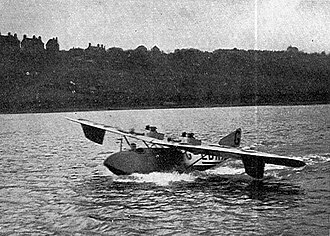 In 1924 Lebbeus once again considered buying an aircraft. The
story is that he wanted to go fishing around the Botany Bay area. Short
Brothers developed the tiny Short Cockle, all-metal apart from fabric-covered
flying surfaces, powered by two 670 cc engines of 16 hp (12kW) engines started
by mechanism similar to a motorcycle kick starter.
Performance was unsatisfactory, and Lebbeus did not accept delivery. Shorts
continued developing the aircraft for another year, but it was never
successful, However, the experience gained with all-metal construction was very
useful for Short’s later aircraft.
In 1924 Lebbeus once again considered buying an aircraft. The
story is that he wanted to go fishing around the Botany Bay area. Short
Brothers developed the tiny Short Cockle, all-metal apart from fabric-covered
flying surfaces, powered by two 670 cc engines of 16 hp (12kW) engines started
by mechanism similar to a motorcycle kick starter.
Performance was unsatisfactory, and Lebbeus did not accept delivery. Shorts
continued developing the aircraft for another year, but it was never
successful, However, the experience gained with all-metal construction was very
useful for Short’s later aircraft.
Divorce
In August 1919, Olga had left Australia to live in Europe with her son, as mentioned on page 10. It was obvious that there were serious marriage problems. Lebbeus had agreed to pay an annuity of £8000 per year after tax.
Disagreements came to a head in the early 1924, starting a complex series of legal manoeuvres. Over the next two years teams of eminent lawyers for both sides battled in the court reported in salacious detail s, with every development reported nationwide in salacious detail in over 250 major news articles. For much of this time Olga and her son were overseas.
On 14 May 1925 Lebbeus himself suddenly travelled to Hong Kong. A few days later the court heard evidence that Lebbeus Hordern had committed adultery with Evelyn Honoria Willis at the Savoy Hotel, London; the Piccadilly Hotel, London; at Brighton, and at other places in London, between January 1, 1920 and March 31, 1920. A daughter, Barbara Lebbeus Hordern, had been born, and Evelyn, listed as being a shop assistant, was named as the mother[1].
The judge issued a divorce decree which resulted in the final dissolution of the marriage on 20 January 1926. Lebbeus contracted to pay Olga £10,000 a year and she retained custody of the young Lebbeus. They lived in Europe.
Remarriage: February 6, 1925
Just over a fortnight later, Lebbeus married again. The bride was Miss Frances May Barry, described in the press as ‘a daughter of Mr G J Barry, a well-known Sydney solicitor’ … ‘a pretty, slim, dark-eyed girl of 27’. Only two witnesses attended the ceremony at the Adelaide registry office ceremony; Frances had arrived from England on the steamer Cathay that morning.
A single press reporter was present. His account was widely copied. The bride was described as being clad in in ‘a dainty green travelling costume of serge with a bow at the neck’ and the Sydney Truth recorded that women rushed to buy ‘green dress materials of all descriptions’. ‘The colour chosen by the fortunate damsel, who drew one of the biggest prizes In the matrimonial stakes, couldn't be classed as ‘unlucky’.'
They drove back to Sydney and took part in the social scene, but did not get the coverage of previous years. Lebbeus formally resigned from the family firm.
In the last two years of his life, the name Lebbeus Hordern appeared in 80 newspaper articles, well down on its usual average. The new Mrs Lebbeus Hordern got almost as coverage on her own behalf as she did as part of the couple. There were also reports of Olga’s glamourous activities overseas, casting a shadow over the current situation.
There were soon other signs that all was not well with the marriage. Towards the end of 1926 the fate of the Felixstowe F3, as described on page 15, would have been depressing. There were some (probably pointed) press comments that during the early part of 1927 Frances spent some considerable time in Melbourne.
After Lebbeus’ death Miss Maude Chilvers claimed £10,000 from the estate, saying that this was for work done as confidential secretary. She also alleged that Lebbeus had promised to marry her, and said that he would provide for her in the event of his dying before this could happen.
On Friday 10 December 1926 the Sun printed an amazing article, entitled SUCCESS: AIM OF THE BLIND BUT ATHEISTS FAIL. It was deep and thoughtful – very rare for the Sun – and written by Lebbeus, almost uniquely in the available records. It talks fundamentally about fame, and, indeed, the meaning of life. Here is a brief summary, but it is worthwhile to read the original for yourself: it is easily found on Trove.
He seeks a definition of what success is and how people strive to achieve it, but comes to the conclusion that success cannot be defined: ‘the more success is pursued the further it recedes’. This pursuit is an obsessive and brutal task. The person forgets that ‘at times he should stand aside to regain equilibrium and purity of thought’.
Faith is vital, because if it is not there, the person ‘lives in a state of perpetual decay, denying the Life that breathes joy, beauty, hope, into every moment of eternal existence’. When people cannot see this, their strength Is tested to the utmost. Philosophy, (love of knowledge) ‘enables people to survive until their craft of life sails untroubled to its destination’.
During these few years Lebbeus had often given prizes of a few hundred pounds for various forms of aerial endeavour, particularly in support of local design and manufacture if light aircraft. He also negotiated with Short Brothers about buying a new aircraft as described on page 27.
Om 9 June 1928 Kingsford-Smith and his crew completed their flight from America in the Southern Cross. Three days later, the Aero Club held a dinner at Farmers store in Sydney, at which a cheque for £5,000 was presented to the airmen on behalf of Lebbeus. This amazing donation dominated the publicity received by Lebbeus over the next few months, but it interesting to note that Lebbeus himself did not attend the gathering.
He did attend another celebration of the airmen but decline an invitation to speak. This is good evidence that he was in a state of depression. .
In his Sun article (page 30) he had said that ‘ each night is but a mock of sleep, and each day success arises to fresh duties …’
For some time, he had been taking Luminal barbiturate tablets, more popularly known at the time as phenobarbs.
On the morning of September 19 1928, he was found dead in bed. The coroner’s verdict was that he had died of an overdose of barbiturates, self-administered. It is not clear whether this was accidental or deliberate. He was 37 years old.
A lavish funeral was held, and press comment on his life was very favourable. Six aircraft in formation flew over the funeral ceremony.
Aftermath
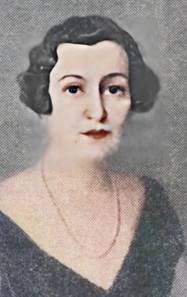 Olga,
about 1930
Olga,
about 1930
First reports were that Lebbeus had left an estate of about a million pounds, enough to maintain his payments to Olga and to support Frances equally well. But it was soon found that the value was considerably less. Over the next year or so, Lebeus’ assets were sold, including jewellery he had given to Frances. The final value of his estate was £356,846/15/6, which was insufficient to pay the alimony, for Olga and a similar allowance for Frances. Some very complicated legal action followed, and in 1936 Olga surrendered her yearly allowance for a lump sum of about £125,000.
In 1930 she had married Signor de Romero, a Spanish diplomat at Paris. This may not have been a good move, as he lost his high-status position when King Alfonso XIII of Spain abdicated as Spain lurched towards the 1936 civil war. She was at pains to make it clear that her husband was independently wealthy. She often figured in the social pages in England and Australia till the mid-1950s.
Lebbeus Hordern junior had had a high-class education and was a highly qualified engineer and an arts graduate from Cambridge. When he turned 21 in April 1935, he inherited a huge fortune, perhaps £3,000,000, from his grandfather’s estate. He joined the Fleet Air Arm and had a distinguished war career; he was awarded a DSC for an attack on the German battlecruiser Tirpitz in 1944. I think his father would have been very proud – and envious.
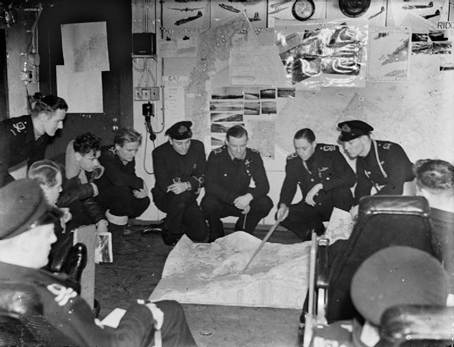
Lieutenant
commander Lebbeus Hordern (with pointer), Commanding Officer, 896 Squadron
Fleet Air Arm, on HMS Pursuer, (escort carrier), mid-1944.