First to the Solomons
Williams Pacific Flight 1926
Edited by Tom Lockley
In September-November 1926, Group Captain Richard Williams, Chief of Staff of the Royal Australian Air Force, led an exploratory flight to islands north of Australia. This was the first overseas flight of a RAAF aircraft and was, for much of the journey, the first aircraft to visit.
Contents
Williams ’ concluding comments:
The 1927 round-Australia flight
Later history of the DH-50 in Australia
Philately of the Pacific Flight

With
special thanks to Monica Walsh, Curator of Research, RAAF Musuem Point Cook,
Bob Livingstone of AHSA Queensland and websites Trove, Martin Walker of
Australian Airmail Stamps, Michael Smith (aviator) Aeropedia, ADF-Serials,
Geoff Goodall’s aviation history site, Fliypast
(Parnell and Boughton) – and many others
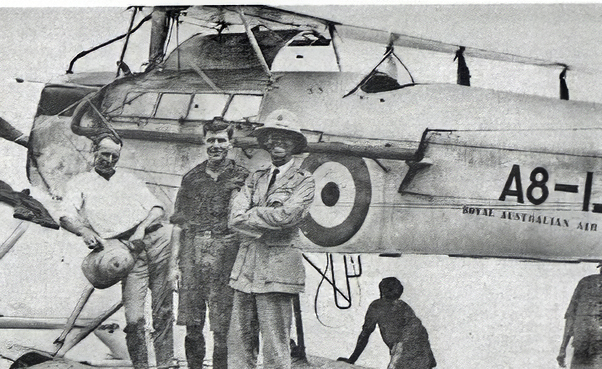 Flight Lieutenant Ivor McIntyre,
Flight Sergeant Les Trist and Group Captain Richard Williams with their RAAF
DH.50A seaplane at Buna, Papua during their historic 6,000
kilometre Pacific Islands survey flight.
Flight Lieutenant Ivor McIntyre,
Flight Sergeant Les Trist and Group Captain Richard Williams with their RAAF
DH.50A seaplane at Buna, Papua during their historic 6,000
kilometre Pacific Islands survey flight.
The major
aviation event in
Australia in 1926 was undoubtedly the flight made by the Chief of the RAAF Air
Staff, Group Captain Richard Williams and his crew along the east coast of
Australia and through Papua New Guinea, New Britain, the Solomon Islands to
Tulagi and return. It was the first RAAF overseas flight, and the first flight
by an Australian-based aircraft to areas beyond Australian territories.
The
hundredth anniversary of the flight is a good opportunity for collecting new
information, particularly at a local level: please contact me at tomlockley@gmail.com if you can help. It may be possible that some commemorative activities will
be held.
The flight
left Point Cook on 25 September 1926 and returned on 7 December. Despite its
importance, it is not well-known to the Australian public, hence this post. The
booklet and file , First
to the Solomons, can be downloaded here.
In 1926, the
RAAF needed to make its presence felt. RAAF personnel Stanley Goble and Ivor
McIntyre had made headlines in 1924 by
making the first flight around Australia, and Richard Williams, Chief of the
Air Staff, was keen to build on this by
making a survey flight of the British possessions in the Pacific, flying some
27,300 kilometres (17,000 miles) to Samoa and return. The object of the flight ‘was
to gain knowledge of the geography and flying conditions of the islands in the
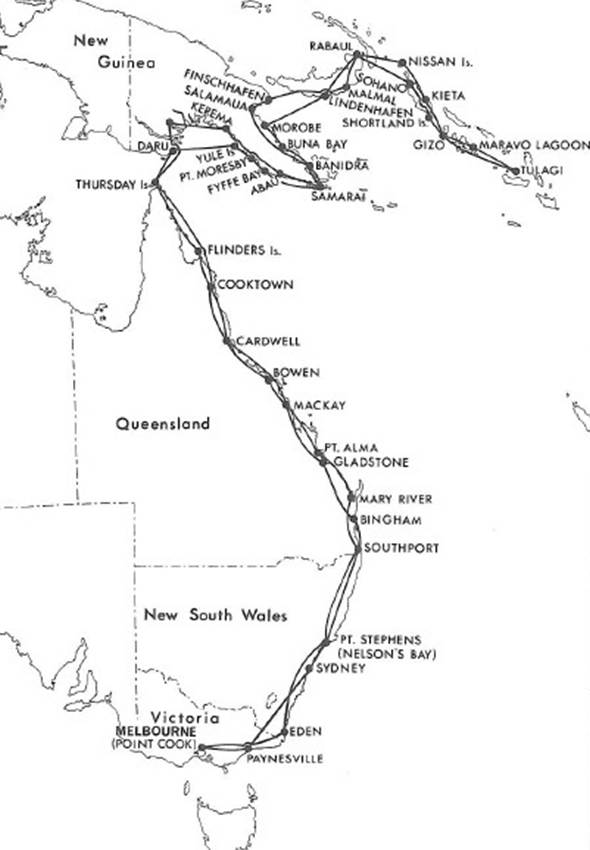
Pacific adjacent to Australia for air defence purposes.’ The planned route for
this pioneering journey was through the islands of Papua New Guinea, Solomon,
New Hebrides, New Caledonia and Fiji, to Samoa and return. However, in the
event, the flight finished at Tulagi, in the Solomon Islands, as per the map on
page 9.
The
subsequent history of Australian aviation in New Guinea, both civil and
military, testifies to the importance of this flight:
·
New
Guinea was an early adopter of air transport. The opening up of New Guinean
gold mining efforts in the late 1920s were very much handicapped by
difficulties of transport: the entire country is mountainous,
there were no roads and aircraft were far more efficient. Amazing feats were
performed in the years before World War
II.
·
During
World War II New Guinea was the theatre for significant battles: air transport in particular was a major factor in the vital victories won
in this area.
·
Modern New Guinea could not survive without the
hundreds of aircraft that enable efficient transport throughout this mountainous jungle country.
And finally the recent conclusion of the Papua New Guinea –
Australia Mutual Defence Treaty once again underlines the importance of mutual cooperation, of which aviation is a vital part.
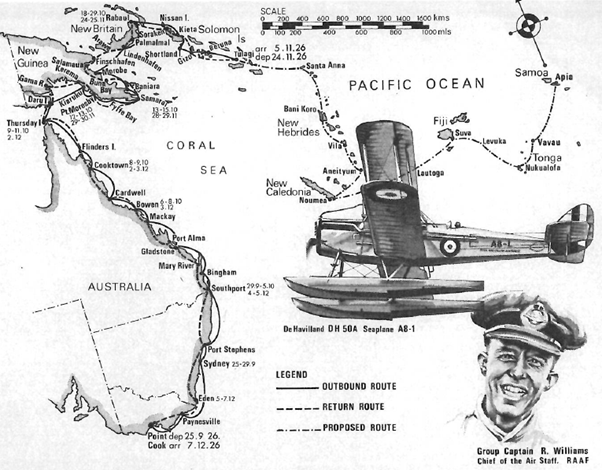 Map from AIRCRAFT, March 1977
Preparations
 Most of the route was over water, and
there were very few landing fields, so a seaplane was desirable . The best
choice was the DH.50A, which had been ordered with an interchangeable wheel and
float undercarriage. It was a modern-looking aircraft with an enclosed cabin
for up to four passengers. Importantly, the Siddeley Puma engine of the DH.50A,
with its low compression, permitted the use of ordinary motor spirit which was
the only kind of fuel available for most of the journey. The logistics for the
Goble / McIntyre flight around Australia were very challenging as supplies of
aviation fuel and oil had to be relocated at 37 sites around the coastline.
Goble had only succeeded in getting ministerial approval for his flight because
he was acting Chief of the Air Staff in 1924 when Williams was overseas. In
1925 the situation was reversed: Goble was overseas.
Most of the route was over water, and
there were very few landing fields, so a seaplane was desirable . The best
choice was the DH.50A, which had been ordered with an interchangeable wheel and
float undercarriage. It was a modern-looking aircraft with an enclosed cabin
for up to four passengers. Importantly, the Siddeley Puma engine of the DH.50A,
with its low compression, permitted the use of ordinary motor spirit which was
the only kind of fuel available for most of the journey. The logistics for the
Goble / McIntyre flight around Australia were very challenging as supplies of
aviation fuel and oil had to be relocated at 37 sites around the coastline.
Goble had only succeeded in getting ministerial approval for his flight because
he was acting Chief of the Air Staff in 1924 when Williams was overseas. In
1925 the situation was reversed: Goble was overseas.
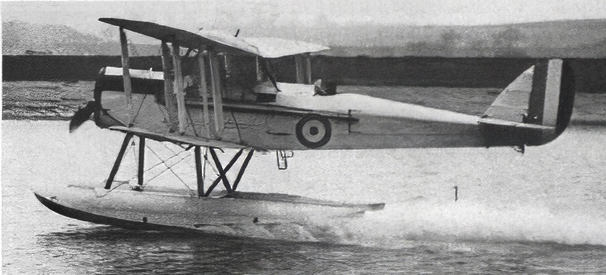
The DH.50A
had been tested as a seaplane at Shorts works at Rochester, UK ( picture above)
in April 1926. The aircraft was formally accepted for the RAAF on May 4, 1926,
by Stanley Goble in his role of Commonwealth Liaison Officer at the Air
Ministry, and it was then shipped to Australia. It arrived at RAAF Point Cook
in August 1926 and was given the serial number A8-1 and it became the first
aircraft to be labelled ‘Royal Australian Air Force’ – in small letters under the serial number.
After much
effort, ministerial approval was gained for the flight, despite concerns over
safety issues.
 The aircraft was quickly prepared for
the flight. The twin floats were fitted and Williams
personally tested the seaplane on the 11 September. There were very
few aircraft radio stations along the route, so it was decided not to carry a
wireless operator and 54kg (120 1b) of wireless equipment was removed. Because
they had only a three-person crew, they were able to carry a considerable number
of tools and spare parts, which proved to be of great benefit.
The aircraft was quickly prepared for
the flight. The twin floats were fitted and Williams
personally tested the seaplane on the 11 September. There were very
few aircraft radio stations along the route, so it was decided not to carry a
wireless operator and 54kg (120 1b) of wireless equipment was removed. Because
they had only a three-person crew, they were able to carry a considerable number
of tools and spare parts, which proved to be of great benefit.
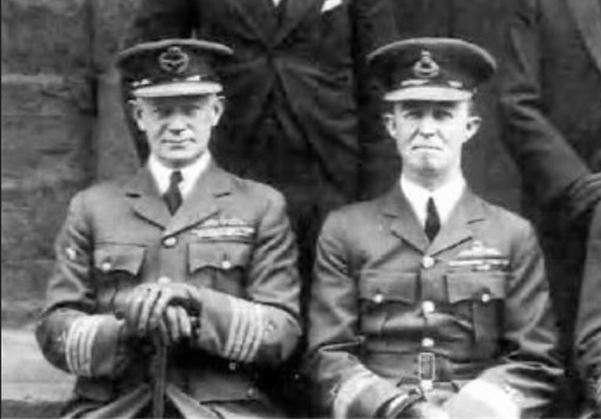
A rare
picture of Goble (left) and Williams together, 1930.
The crew
Air
Marshal Sir Richard Williams, KBE, CB, DSO (1890-1980) 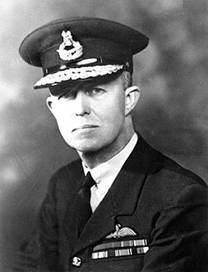 was a self-made man. His father was a miner. Aged 19, he enlisted in the
South Australian Infantry Regiment and was commissioned in 1911. In November
1914 he graduated from the first -flying course held at the Central Flying
School, Point Cook, Victoria.
was a self-made man. His father was a miner. Aged 19, he enlisted in the
South Australian Infantry Regiment and was commissioned in 1911. In November
1914 he graduated from the first -flying course held at the Central Flying
School, Point Cook, Victoria.
Late in 1915
he joined the first Australian aviation unit sent overseas for service with the Royal
Flying Corps. The squadron began operations as a separate entity in
December1916, supporting the Egypian Expeditionary
Force in the advance towards Palestine. Richard Williams was awarded the
Distinguished Service Order for acts of conspicuous gallantry and assumed
leadership roles. He finished the war as temporary lieutenant-colonel, second
in command of 4th (Army) Wing, Palestine
Brigade, RFC.
Despite his
comparatively young age (and his working-class background), his administrative
skills were recognised, and he took a prominent part in setting up the Royal
Australian Air Force and in 1922 was became chief of the Air Staff. He
continually worked towards developing a strong and independent air force. In late 1926
he led the flight to the islands north of Australia which is the subject of this
booklet.
Williams had
a distinguished career in the Australian air force and held important overseas
positions. During World War II however, Australian officers were denied the
opportunity of commanding the Australian air force. The situation is very
complex and has been the subject of many PhD dissertations, impossible to
summarise in this short document. After the war Williams became Director-General
of civil aviation and his work over the next ten years certainly ‘created the
network of airfields, communications and related support services required by
the industry, while maintaining an enviable safety record’. But that is another
story!
Lieutenant
Ivor Ewing McIntyre, CBE, AFC (1899-1928) was born in Scotland. During World War I he
served with the Royal Naval Air Service and was a very skilled aviator,
specialising in seaplanes. He came to Australia in 1923 to take up a commission
in the RAAF, and took up duty with 5 Squadron RAAF, flying Fairey IIID
seaplanes, based at Point Cook. He
immediately took part in major flights, notably the first flight around
Australia, as pilot for Wing Commander Stanley Goble. His pre-eminence as seaplane pilot is shown
by the fact that he was also selected for the Williams flight. Ivor remained in
the air force until 1927 and then became chief instructor for the South Australian section of the Australian
Aero Club. Sadly, he was killed in the crash of a Cirrus Moth on 11 March 1928.
Flight
Sergeant Leslie Joseph Trist (1898-1931) joined
the army in 1918. He was a talented engineer and secured a position in military
aviation. In 1926 he was a Sergeant in the RAAF and is listed as ‘mechanic’ in
the records of the Pacific flight. He
left the RAAF in 1927 and joined Airgold, a pioneering air
transport firm in New Guinea, as pilot. Guinea Airways took over Airgold,
and Les joined them as pilot. He was
an important pioneer of the wonderfully successful air transport services in
New Guinea and was killed in the crash of a Junkers W34 on 22 May 1931.
Diary of the expedition
Friday, 24 September: planned date of departure, but a rough sea
off Point Cook prevented the heavily laden seaplane from lifting off.
Saturday,
25 September: Point Cook
to Paynesville (fuel stop), 0550-0850, duration 3.00: When the seaplane alighted at
Paynesville, on the Gippsland Lakes in Victoria, to take on fuel, it was found
that a small external leak had developed in the engine's water jacket. Paynesville
to Sydney, 1019-1540, duration 5.21: the aircraft landed in Rose Bay amidst
the normal Saturday afternoon's conglomeration of pleasure craft on Sydney
Harbor.
The
seaplane was beached and, after an inspection of the leaking water jacket, it
was decided to change the engine. The replacement Puma – one of those supplied
with the 1920 Imperial Gift equipment – was obtained from Wing Commander L J
Wackett's RAAF Experimental Section at Randwick. The engine change took three
days, and the aircraft was ready to resume the flight on the 29th.
Wednesday 29 September: Sydney
to Nelson Bay, (fuel)1035-1140, duration 1.05. Departure time was set for
1000 hours, but McIntyre had to taxi the seaplane around for 35 minutes to stir
up the smooth water surface to enable the aircraft to lift off! (This indicates
the narrow margins on which the aircraft operated! tl). Nelson Bay to
Southport, Queensland, 1235-1800, duration 5.25. Strong headwinds. Shortly before 1700 hours,
when the fliers were within 9.7 kilometres (six miles) of Southport, the engine
suddenly failed and McIntyre had to make an emergency landing in the open sea.
It was found that a split-pin had been dislodged from the pilot's throttle
control, and the fault was quickly remedied. High seas, with waves of 3-3.6m
(10-12ft) were running and it was impossible to take off again, so McIntyre set
about taxiing some eight kilometres (five miles) to Southport. The failing
light, and the spray from the breakers, prevented the crew from locating the
entrance to Southport, and McIntyre had to skilfully taxi ashore through a high
breaking surf. The firing of a Very light brought assistance
from the local cinema which was screening a silent epic. A party of 50 men
dragged the machine across the sand-dunes to a lagoon where McIntyre taxied to
a secure position in front of the Grand Hotel. Over seven hours had elapsed
since the forced landing, and the exhausted crew collapsed into their beds
during the early hours of 30 September.
 Thursday, 30 September: An inspection carried out later in the morning
revealed that the propeller had been badly damaged and would have to be
replaced. The only suitable propeller available was in the process of being
built at the RAAF Experimental Section. Work on this propeller was hurriedly
completed.
Thursday, 30 September: An inspection carried out later in the morning
revealed that the propeller had been badly damaged and would have to be
replaced. The only suitable propeller available was in the process of being
built at the RAAF Experimental Section. Work on this propeller was hurriedly
completed.
Meanwhile, the unfortunate incidents that had occurred to the seaplane since
the fliers left Point Cook were being adversely reported in the newspapers. In
fact, the Acting Minister for Defence was even called upon to cancel the flight.
In the official report of the flight subsequently compiled by Williams he commented that ‘up to this time there had been a certain
amount of press criticism regarding the flight. When the leak developed in the
water jacket in Sydney it was said that this was to have been expected, as the
Puma engine, which was being used, usually developed internal trouble in the
water jacket. The one developed on the flight was external. When the machine
failed to get off after the forced landing at Southport, it was assumed, in the
press, that the reason was due to the limited performance of the machine. This
was not so, for no seaplane could possibly have taken off from the sea running
on that day.’
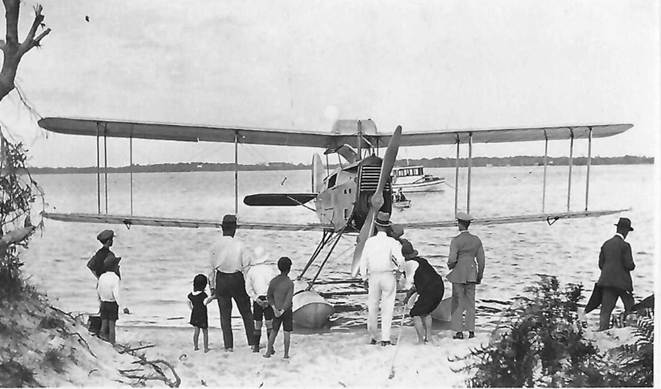
Preparing
to leave Southport (RAAF photo)
Monday,
4 October: The propeller arrived at Southport. It was
fitted and tested immediately, and the seaplane was readied for departure on
the following morning.
 Tuesday, 5 October:
Southport to Bingham (fuel, near mouth of Mary River, Hervey Bay)
0620-0920, duration 3.00. Bingham to Gladstone 1040-1320, duration 2.40.
Tuesday, 5 October:
Southport to Bingham (fuel, near mouth of Mary River, Hervey Bay)
0620-0920, duration 3.00. Bingham to Gladstone 1040-1320, duration 2.40.
This RAAF
picture is labelled ‘Island Survey Flt. at Ashgrove, QLD’. But there is no
mention in the sources of a stop at the
Brisbane suburb of Ashgrove.
Wednesday,
6 October: Gladstone
to Mackay, (fuel), 0650-1010, duration 2.40. Mackay to Bowen, 1105 to 1240,
duration 1.25. The DH.50A was met and escorted into Bowen by one of the Seagull
Ill amphibians of No 101 (Fleet Co-operation) Flight which was stationed in the
area.
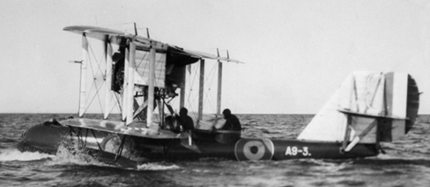 Thursday, 7 October: The aircraft remained at Bowen. Williams, as Chief of the
Air Staff, inspected the flight, and flew out to the section of the Great
Barrier Reef that was being photographed by the Seagull crews. A9-3 is shown.
Thursday, 7 October: The aircraft remained at Bowen. Williams, as Chief of the
Air Staff, inspected the flight, and flew out to the section of the Great
Barrier Reef that was being photographed by the Seagull crews. A9-3 is shown.
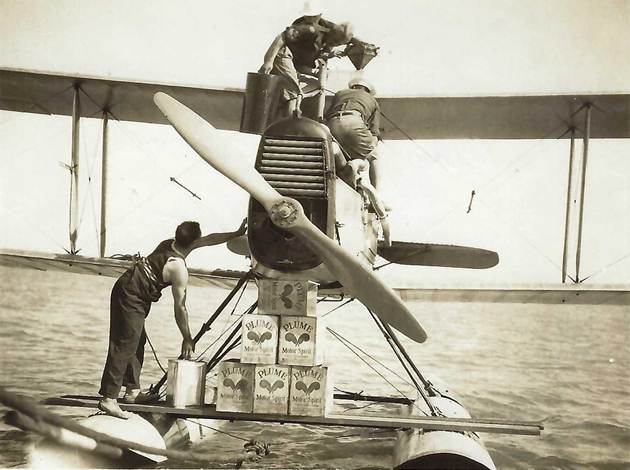
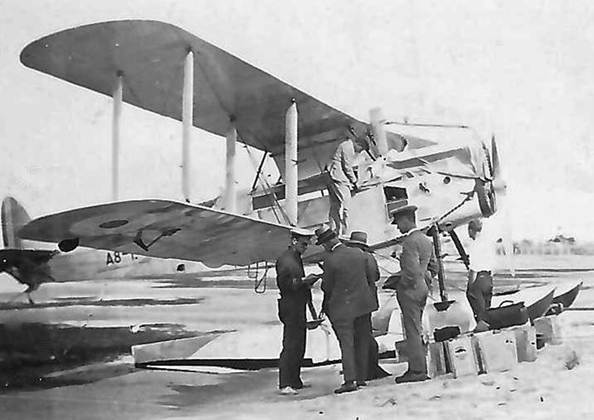
‘Filling up at Bowen’ – RAAF picture
There had not been much press coverage of the flight, but this increased
considerably after they left Australia. This article is from the Sydney Sun of
Monday 11 October.
Friday, 8 October: Bowen to
Cardwell (fuel), 0935 to 1150, duration 2.15; Cardwell to Cooktown, 1237-1450,
duration 2.13.
Williams: The next day via Cardwell we arrived at Cooktown. Here the
whole town, a small handful of people, turned out to greet us and when
proceeding to the hotel after refuelling, the mayor asked me if we would like
to attend a dance that evening. Personally I did not
feel a bit like a dance but it was obvious that the
local people would like us to do that, so I said we would. Whilst we were
having dinner at the hotel I heard a brass band
playing in the distance and commented on such a small community being able to
raise a brass bd. I was told it was playing at the hall where the dance was to
be held.
When we arrived at the hall the band
was playing outside, but before dancing commenced the whole band moved inside.
The hall was built of corrugated iron without any lining
and we certainly could hear the music, but we could not talk to our partners.
Everyone was there including the children, some babies were in prams parked
around the hall whilst here and there one was lying asleep on a form against
the wall, quite capable of rolling off I thought but none did. It was quite a
pleasant evening and seemed very quiet when the band had completed its program.
Saturday,
9 October: Cooktown to Flinders Island 1120-12.35, duration 1.15 (fuel); Flinders
Island to Thursday Island 1328—1700, duration 3.32.
 The
airmen stayed with the
Garrison Artillery unit which was maintained there at that time.
The
airmen stayed with the
Garrison Artillery unit which was maintained there at that time.
At this point the DH.50A was about to become  the
first locally based aircraft to fly out of Australia. AIRCRAFT magazine later commented that ‘after an
exchange of telegrams with Defence Headquarters on the advisability of pushing
ahead or returning to Melbourne, the flight was resumed to Papua. … a section
of the press was printing a lot of sheer nonsense about the difficulties
encountered during the early stages of the flight. The then Minister for
Defence was in England. His Acting Minister seems to have lent a credulous ear
to those who wanted to have the flight stopped at Thursday Island and for a
while there was some real danger of their representations being acted upon …
actually, the flight didn't begin to grow interesting until after leaving
Thursday Island, for most of the places called at in the Pacific had never
previously been visited by aircraft.’
the
first locally based aircraft to fly out of Australia. AIRCRAFT magazine later commented that ‘after an
exchange of telegrams with Defence Headquarters on the advisability of pushing
ahead or returning to Melbourne, the flight was resumed to Papua. … a section
of the press was printing a lot of sheer nonsense about the difficulties
encountered during the early stages of the flight. The then Minister for
Defence was in England. His Acting Minister seems to have lent a credulous ear
to those who wanted to have the flight stopped at Thursday Island and for a
while there was some real danger of their representations being acted upon …
actually, the flight didn't begin to grow interesting until after leaving
Thursday Island, for most of the places called at in the Pacific had never
previously been visited by aircraft.’
(Sunday,
10 October: delay awaiting approval to proceed)
Monday, 11 October: Thursday
Island - Daru Island, Papua[1],
0817-1000, duration 3.32, 209 kilometres (130 miles) across the Torres Strait.
Williams: The water round these islands seems
never to be clear of driftwood or other rubbish and we damaged our airscrew in
trying to take off from Daru. Fortunately, it was repairable, but we had to
stay there the night.
Tuesday, 12 October: Daru-Kairuka
(Yule River), 1134-1500, duration 1.43, Kairuka-Port Moresby
1720-1810 duration 50 minutes. They flew along the Fly River Delta, and across
the top of the Gulf of Papua where the aircraft flew into its first tropical
storm. After landing at Kiaruku qq, Yule Island, for
fuel, they reached Port Moresby at 1720 hours.
Willians: At Yule Island we met a number of young Australian
nuns. It was dark by the time we got ashore at Port Moresby
but we were met on the wharf by the Administrator, Staniforth Smith, who was
acting for the Lieutenant-Governor, Sir Hubert Murray, who was on leave.
I stayed at Government House that night.
Wednesday, 13 October: Port
Moresby-London Mission Station at Fyffe Bay (fuel) 0959-1312, duration 3.13;
Fyffe Bay-Samarai Islandqq 1515-1610 duration 55
minutes.
Williams: Our next destination
was Samarai, but en route we landed at the London Mission Station in Fyfe Bay
and accepted an invitation to lunch there. Up till now all the Papuan natives
we had seen were what we call fuzzy-wuzzies, that is they wore a large quantity
of curly hair.
Most of the missionaries we met seemed to live fairly
comfortably. In the course of training the
natives, all the labour they needed, whether inside the home or elsewhere, was
available to them. 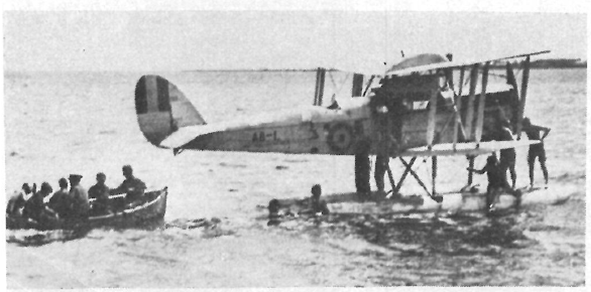 Thursday, 14 October: Torrential
rain held up the fliers for 24 hours at Samarai where they were guests of the
Bishop of New Guinea.
Thursday, 14 October: Torrential
rain held up the fliers for 24 hours at Samarai where they were guests of the
Bishop of New Guinea.
Typical of the many PNG departure scenes, this
picture shows the crew being taken out to A8-I and natives swimming around the
floats note the repaired rudder with the
red, white and blue stripes partly obliterated. (Isaacs’ original caption, RAAF Point Cook
photo)
Friday, 15 October: Samara-Baniara
0933-1050, duration 1.17, Baniara-Morobe 1224-1520. Duration 2.56. While
crossing Milne Bay the aircraft ran into a heavy tropical storm which caused
the engine to lose power. McIntyre turned back to evade the downpour and, when
the engine subsequently picked up, he flew around the storm area. Morobe was
the first landing made in the Mandated Territory, and the party found a
welcoming wire awaiting them from the Administrator at Rabaul.
Saturday, 16 October: ‘The next
day was hot and muggy without a breath of wind,’ Group Captain Williams
recounted in his report. ‘The surface of the sea was like glass, and a ground
swell was coming in from the ocean. We had planned to fly to Lindenhafen, but
under these conditions it was impossible to get off with the necessary load to
make it in one flight.’
Sunday, 17 October: Morobe-Lindenhafen,
1150-1500. Duration 3.10. Conditions were much better and the seaplane was
flown across the Huon Gulf, via Fami Islands, direct
to Cape Bulli on the south coast of New Britain.
Monday, 18
October: Lindenhafen to Rabaul: 1337-1622, duration 2.45, 362 kilometres (225
miles).
Further telegrams were then exchanged with the Defence Department, culminating
in authority being received to proceed beyond Rabaul – ‘Continuation of flight
to Tulagi approved. Acting Minister desires impress no undue risks should be
taken and feels flight should not proceed beyond Solomon Islands.’
At daylight on the 29th, A8-1 was flight
tested with the two-bladed propeller that had been used since leaving
Southport. The DH.50A was then temporarily fitted with a four-bladed propeller
originally designed for the Wackett Widgeon I amphibian. The Widgeon's
propeller had been positioned at Rabaul so that it  could
be tested in the warmer latitudes. ‘This propeller, however, caused
considerable vibration and It was found to be out of true,’ reported Group
Captain Williams. ‘It was not tested in the air.’
could
be tested in the warmer latitudes. ‘This propeller, however, caused
considerable vibration and It was found to be out of true,’ reported Group
Captain Williams. ‘It was not tested in the air.’
The normal propeller was refitted and
the fliers departed from Rabaul at 1050 hours on the same morning.
After flying across New Ireland and
clearing the east coast, the aircraft ran into rainstorms before arriving at
Nissan Island. An inspection at Nissan revealed that an internal leak had
developed in the water jacket of No 2 cylinder. Temporary adjustments were made
and the flight  continued on October 30 to Kieta.
Tuesday 19
October to Friday 29 October: an eleven day stop at Rabaul. : While
awaiting approval to continue the flight an opportunity was taken to
top-overhaul the engine. This work was completed on October 26, when a test
flight was carried out. A Customs launch drifted into the tail of the machine
and severely damaged the rudder. Wednesday, 27 October and Thursday, 28 October
were occupied with repairs:
.Friday, 29 October: At daylight the aircraft was flight tested
with the two-bladed propeller that had been used since leaving Southport. Then it was fitted with a four-bladed
propeller originally designed for the Wackett Widgeon I amphibian. The
Widgeon's propeller had been positioned at Rabaul so that it could
be tested in the warmer latitudes. This propeller, however, caused considerable
vibration and it was found to be out of balance, and the normal propeller was
refitted.
Rabaul-Nissan Island, 1050-1300, duration 2.10. After flying across New Ireland and clearing
the east coast, the aircraft ran into rainstorms before arriving at Nissan
Island. An internal leak had developed in the water jacket of No 2 cylinder.
Williams reported that water collected
on the piston head when cold but that by soaking up this water with strips of
cloth inserted through the plug hole the engine could be started up and kept
running!
Here we found that we had an internal leak in the
water jacket of one cylinder of our engine and that 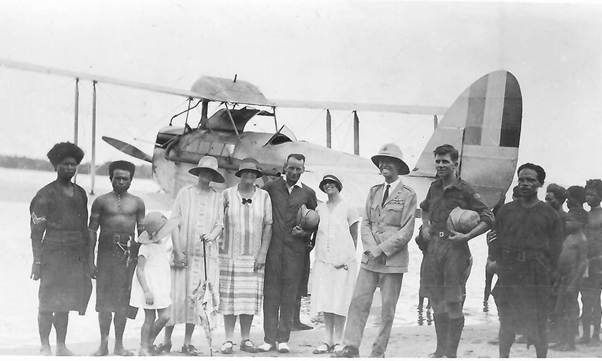 Unfortunately, this RAAF picture
is unlabelled. Because of the repaired rudder, it must have been at Rabaul or
later.
Unfortunately, this RAAF picture
is unlabelled. Because of the repaired rudder, it must have been at Rabaul or
later.
Saturday, 30 October: Nissan
Island-Kieta, 137-1622, duration 2.45.
Sunday, 31 October: Kieta-Shortland
Island. An attempt was made the following morning to fly to Gizo, but a landing
had to be made at Shortland Island because of heavy rain and bad weather along
the rest of the route. The weather, in fact, deteriorated so much that the
aircraft was grounded for the following two days during which time it was found
that the engine sump had cracked. Monday, 1 November and Tuesday, 2 November
were occupied with repairs.
Wednesday, 3 November: Shortland
Island-Gizo, 0850-1020, duration 1.30.
Thursday, 4 November: Gizo-Maravo
Lagoon 0930-11.25, duration 1.15. A second take off for Maravo Lagoon had to be
abandoned when the engine missed and vibrated badly under full power. The
seaplane was beached, and it was found that No 6 cylinder had also developed a
leak in the water jacket. Again, tempo rary adjustments were made—Nos 2 and 6 cylinders were freed
of water through the plug holes, the engine was warmed up, and clean plugs were
then inserted in the faulty cylinders just before take-off —and the fliers
reached Maravo Lagoon and stayed overnight at Betuna.
rary adjustments were made—Nos 2 and 6 cylinders were freed
of water through the plug holes, the engine was warmed up, and clean plugs were
then inserted in the faulty cylinders just before take-off —and the fliers
reached Maravo Lagoon and stayed overnight at Betuna.
Friday, 5 November: Maravo
Lagoon-Tulagi, 11.25-1320, duration 1.55, 241 kilometres (150 miles). The
seaplane was beached immediately at the Burns Philps island, Makambo. As Tulagi
had now been made the terminal point of the survey, a new engine was requested
from Sydney. The only Puma available was the engine that had developed the
leaking water jacket on the flight from Point Cook to Sydney and had since been
repaired at the Experimental Section.
Williams went down with malaria. The
Resident Commissioner came with a doctor, and Williams was dismayed that he was
Chinese, ‘The only Chinese I had ever met up to that time had been market
gardeners or laundry men, and I am afraid this did not fill me with a great
deal of confidence.
However, I found that the doctor had been trained at Edinburgh University and
he proceeded to fill me with quinine until I felt I must burst. He obviously
knew what he was doing for in a few days I was up and about and have not had a
trace of the fever since’
Williams also commented that the
people had not seen an aeroplane before there was consternation in the native
villages as they passed over, men,
women, children, pigs and dogs running in all directions. It was not long
before the aircraft was being referred to by the natives as 'motor car belong
Jesus Christ'. He ‘not very favourably impressed by the operations of European (principally
Australian) storekeepers in the islands’. Most of the
stores were in two sections, one for Europeans and the other for natives, and
in the latter the prices charged were higher for the same article than in the
European section. For example, a hair comb which was sixpence in the European
section was one shilling – twice the price – in the native section. Williams
was told that the natives did not understand anything but shillings, I found
that very hard to believe. ‘Probably the occasion which shocked me most was at
Tulagi when I saw a native outside a store with a camera which he had just
purchased. It was a folding camera, and he was opening and closing it;
obviously he did not understand it nor had he any knowledge of lenses or films,
and of course he could get no photographs with it. It had cost several pounds’
‘Most of the natives employed by
Europeans at that time were under contract for a period. They received a small
weekly payment (perhaps in shillings), and were paid a lump sum, still not a
large amount, on completion of their contract. The native I have mentioned
could have had little more than enough to purchase his camera from such a final
payment. I spoke to the storekeeper about the camera and told him what I
thought of such a sale. His attitude was 'I'm here to sell things – it's not
for me to refuse something a native or anybody else wishes to buy'. I am afraid
this did not make me feel proud of being an Australian.
‘We called at several missions during this flight and sometimes I wondered just
what the natives were being taught; at others I noted that they were being
taught a great deal more of the Bible than I had been.
‘On one occasion at Tulagi I was being taken across the bay to Makambo Island
in the Resident Commissioner's launch. The crew consisted of two natives, one
attending to the operation of the engine and the other to the rudder. Natives
who-had had some training at a mission station were referred to as 'mission
boys' and whilst sitting in the stern of the boat I said to the man on the
rudder, 'You mission boy?' 'Yes', he said, 'me mission boy'; then pointing to
the man at the engine-I asked, 'Him mission boy too?' and was surprised to
receive the answer 'No, him bloody heathen'.
Friday, 12 November: Engine
shipped from Sydney
Sunday, 21 November: Engine
reached Tulagi, engine installation
Tuesday, 23 November: Test
flight in the afternoon
Wednesday, 24 November: Beginning
of return flight: Tulagi-Gizo 0620-0840, duration 2.20; Gizo to Kieta
9.40-1130, duration 1.50; Kieta-Sarakanqq
1205-1310, duration 1.05; Sarakan to Rabaul
1205-1750 duration 2.40.Total for the day was 1,242 kilometres (772 miles),
covered in 7 hours 55 minutes with landings at Gizo, Kieta, Soraken, and Rabaul
where the seaplane alighted just before dark.
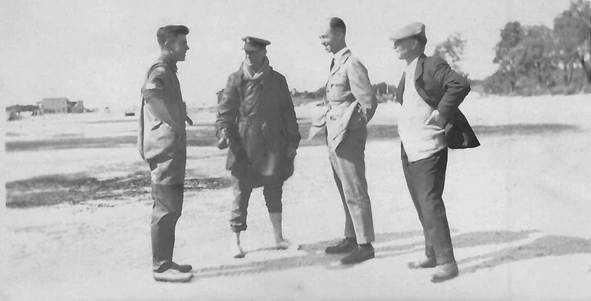 L/R,
Trist, McIntyre, Williams, unknown person, unknown location!
L/R,
Trist, McIntyre, Williams, unknown person, unknown location!
Thursday, 25
November: Take-off at 1750, but forced to return to
Rabaul because of ‘impenetrable storms’ after 30 minutes flying. Rabaul to
Palmalmal (fuel)-1330-1530, duration 2.00:
– ‘a plantation in Jacquinot Bay, managed by an Australian who had
little communication with the outside world, and who inquired as to the winner
of the Melbourne Cup and the result of the last Test match.’ Palmalmal-Lindenhafen
1600-1710, duration 1.10
Friday, 26 November: Lindenhafen-Arawe,
1253-1400, duration 1.07The following morning bad weather delayed the take off
until 1253 hours, and the fliers arrived at Arawe at 1400 hours.
William’s comment: We were
unable to get away from Lindenhafen on 26 November until after midday because
of rain and got only as far as Arawe on the southwest corner of New Britain.
Here we stayed at a coconut plantation, the manager of which was a bachelor and
was away at the time, but who knew of our coming and had instructed his native
boys to look after us. We were there for lunch and the boys produced a tray on
to which a large tin of cold sausages and onions had been emptied. We helped
ourselves to this but did not make much of an impression on it, so it -was on
the table again for the evening meal and again for breakfast next morning. We
did not seem to be very hungry that morning.
Saturday, 27 November: Arawe-Finschhafen
0858-1010, duration 1.13, Finschhafen-Salamoa
1110-1205, Salamoa-Buna Bay 1253-1445,
duration 1.52., Continuous heavy rain
then kept the aircraft grounded until 0900 hours the next morning. After
leaving Arawe the crew flew to Finschhafen, Salamaua, and arrived at Buna Bay
after travelling 470 kilometres (292 miles) in four hours flying time. The
airmen were amazed to find that the next morning the wings were full of water,
but no damage was done,
Sunday, 28 November: Buna
Bay-Baniara1145-1325, duration 1.30, Baniara-Samarai 1355-1510, duration
1.15
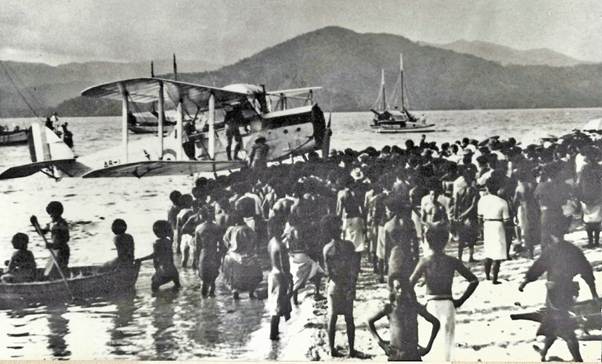 RAAF picture, Williams and
McIntyre at Samarai
RAAF picture, Williams and
McIntyre at Samarai
Monday, 29 November: Samarai-Abau
(fuel)1155-1325, duration 130. Abau-Port Moresby 1357-1520, duration 1.23. Williams:
We were now experiencing rainstorms every day
and although it was possible to get round many of them
we got no further than Port Moresby by way of Abau on 29 November …
Tuesday, 30
November: Port Moresby-Karema 0905-1145, duration 1.18, kilometres (142 miles)
from Port Moresby.
Wednesday, 1 December: Karema-Bamu River 0812-1020, duration 2.08. The weather was still
bad on December I when the fliers took off for Daru. About 90 minutes out from
Kerema the aircraft encountered a storm of such magnitude that McIntyre was
forced to turn back, and he alighted on the Gama River. The crew tied the
seaplane to the river's bank and took shelter in a native hub with five of the
local inhabitants. Efforts to speak to the natives in Pidgin English were
unsuccessful and they waited until the rain had cleared. Bamu
River-Daru 1300-1410, duration 1.10. The Resident Magistrate was most
interested in the behaviour of the natives at Gamaqq
River, because they had not seen a white man for two and a half years. On that
occasion two village constables were appointed – but, when they arrived in
their respective villages, they were promptly disposed of by the local
inhabitants!
Thursday, 2 December: Daru-Thursday
Island (fuel) 1008-1135, duration 1.27 Thursday Island-Flinders Island (fuel)1250-1645,
duration 3.55, Flinders Island-Cooktown 1705-1850, duration 1.45, total
distance 853 kilometres (530 miles)., 7 hours flying. ‘It was a good day’
(Williams).
Friday, 3 December: Cooktown-Cardwell
0710-0940, duration 2.30, Cardwell-Bowen 1000-1220, duration 2.20, Bowen-Mackay
1340-1505, duration 1.25, duration 1.45, and Mackay-Port Alma 1529-1830,
duration 3.01, completing 1,143 kilometres (710 miles) in 9 hours 15 minutes
flying time.
Saturday, 4 December: Port Alma-Gladstone
0906-0930, duration 24 minutes, Gladstone-Mary River 1027-1230, duration 2.03, Mary
River-Southport 1331-1547, duration 2.16, total 595 kilometres (370 miles).
Sunday, 5 December: Southport-Port
Stephens 0743-1105 (fuel), duration 3.22; Port Stephens-Eden 1242-1622,
duration 3.40. The original intention was to fly to Sydney but, with such fine
weather and favourable winds, Williams decided to bypass the harbor and proceed
to Eden. Unbeknown to Williams reception
had been arranged at Sydney and a formation of RAAF aircraft flew out to escort
the aircraft into Rose Bay. When the seaplane failed to appear, fears for the
safety of the crew began to grow until a sighting report of the seaplane was
received from Jervis Bay.
Monday, 6 December: Bad
weather kept the fliers at Eden on the 6th— the first and only day on which a
flight was not made since leaving the Solomon Islands.
Tuesday, 7 December: Eden-Paynesville
0835-1133, duration 2.10, Paynesville-Point Cook 1045-1445, duration 2.10. Two
Fairey III seaplanes had been launched to meet them
but they failed to make contact. Three
SE 5A fighters, and nine Avro 504 trainers then took off and accompanied them CAS's aircraft to Point Cook,
where they alighted at 1512 hours, at the end of its epic journey. contact.
Summary:
The Pacific
islands survey flight of 16,000 kilometres (10,000 miles) occurred between
September 25 and December 7, 1926, and 126 hours 4 minutes were flown on 31
flying days. Of the 23 areas visited in Papua, the Mandated Territory of New
Guinea, and the British Solomon Islands Protectorate, 20 of the districts had
never seen an aircraft. The remaining three were visited by a Vought UO-I
floatplane from an American battleship which called at the islands on the
return voyage from Australia after the visit of the United States Fleet in
1925.
In
retrospect, the flight would have been even more successful but for the
misfortunes encountered with the seaplane's temperamental Puma engine. The fast
return flight of 8,121 kilometres (5,046 miles) in 13 flying days demonstrated
what could be achieved when the engine functioned normally and, of course, the original intention of
surveying 27,300 kilometres (17,000 miles) to Samoa would have been
accomplished but for the engine malfunctions.
In
recognition of the fliers pioneering and surveying achievements, Group Captain
Williams was awarded a CBE, Flight Lieutenant McIntyre a Bar to his AFC, and
Flight Sergeant Trist an AFM, in the 1927 Birthday Honours. McIntyre also
received the Oswald Watt Gold Plaque for 1926 (‘for achieving the most
brilliant performance in the air during the year in the Commonwealth of
Australia’) having previously been awarded the same medal in 1924 for the RAAF
Fairey IllD seaplane flight around Australia. In his History
of Australian Aviation (The Hawthorn Press, 1960), Stanley Brogden relates
that ‘the flight was hailed at the time in England as another triumph for
British aircraft.’
‘Of more
importance than the honours and tributes. however, was the original report of
the flight compiled in 1927 by Richard Williams. This comprehensive defence
assessment was submitted to the Minister for Defence on May 31. The report
formed the basis for strategic air planning in the Pacific islands adjacent to
Australia until the advent of the 1939-45 War; when, of course, the PNG-New
Ireland-Solomons theatre of war became an Achilles' heel in the Japanese plan
to conquer the Pacific. There is no doubt that of all the flights made by Air
Marshal Sir Richard Williams, RBE, CB, DSO, the most significant was his 1926
strategic survey.
Williams summary indicated that he certainly had not been
converted to the merits of seaplanes. His view was definitely
that they should only be used if there was no landing field available.
The Prime Minister at this time was Stanley Bruce, who was
then in London, and he sent a congratulatory cable: ‘Congratulations on
splendid achievement in your flight of ten thousand miles. You have
demonstrated the wonderful possibilities of aviation, not only in linking
Australia more closely with outlying portions of the Empire in Pacific, but
also in defence of Australia and adjoining possessions.’
The 1927 round-Australia flight
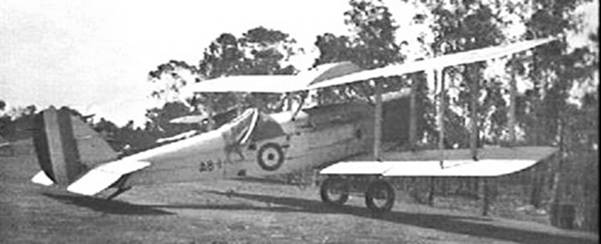 The DH50A was reconfigured as a landplane and was flown by Williams on a
reconnaissance flight around Australia, with an additional flight from Adelaide
to Tennant Creek, Two DH 9s accompanied
the DH 50A for most of the way, and between July and September, the three de
Havilland aircraft covered almost 13,000 miles.
The DH50A was reconfigured as a landplane and was flown by Williams on a
reconnaissance flight around Australia, with an additional flight from Adelaide
to Tennant Creek, Two DH 9s accompanied
the DH 50A for most of the way, and between July and September, the three de
Havilland aircraft covered almost 13,000 miles.
DH50A at Fannie Bay, Darwin, 1927
Later history of the DH-50 in Australia
The DH50A
used by Williams was written off in a crash in 1929. The type was popular in
Australia and a total of 16 DH-50s were actually built
in Australia under licence from de Havilland. QANTAS supplied a DH-50 to what
became the Royal Flying Doctor Service in 1928 (below).
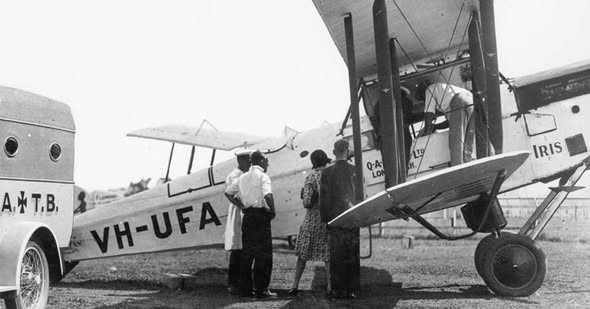
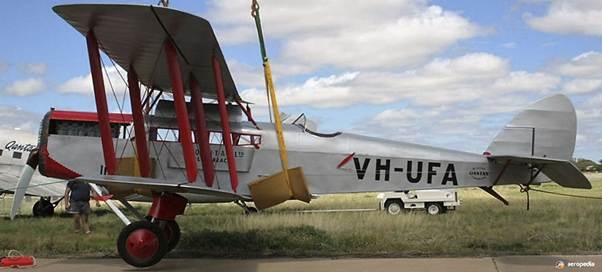
The
original VH-UFA (above) and its replica at Qantas Founder’s Museum Longreach
(David Eyre collection)
Philately of the Pacific Flight
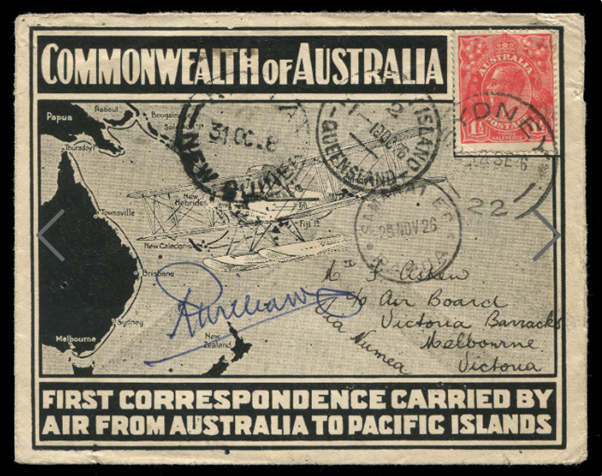 From Leski stamp sales catalogue, 2008:
‘A specially printed cover flown and signed by Group Captain Richard Williams
on his survey flight which originated in Melbourne. This example addressed to
the Air Board, Victoria Barracks, Melbourne with date stamps of ‘SYDNEY’, ‘THURSDAY
ISLAND 10 OC 26’, ‘KIETA 31 OC 26’ and ‘SAMARAI 29 NOV 26’ . One was sold at
Aeropex in Adelaide, December 2019 for $16,000.
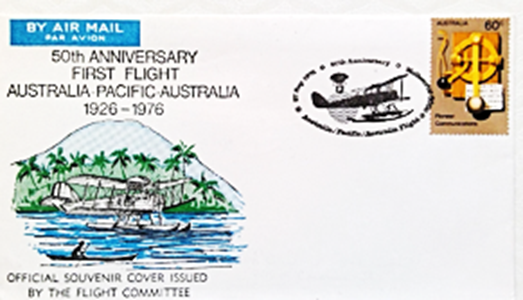
Some covers were carried on a 50th
anniversary flight in 1976 and others in a 75th anniversary flight in 2001.